Table of Contents
Most precast project risk is decided inside the precast concrete plant, not on the construction site. The element that arrives straight, dimensionally accurate, and at full strength was made that way by the plant's batching control, casting discipline, and curing regime. The element that arrives cracked, warped, or weak failed in the same place. For an EPC contractor or developer choosing a precast partner, understanding how a precast concrete plant works is the difference between buying a product and buying a problem.
This guide explains what a precast concrete plant is, how a precast concrete manufacturing plant runs station by station, the types of precast concrete plants in use, and how to evaluate precast concrete plant manufacturers before the contract is signed.
What Is a Precast Concrete Plant?
A precast concrete plant is a factory that casts structural and architectural concrete elements, columns, beams, wall panels, slabs, staircases, and more, in reusable moulds under controlled conditions, then cures them to strength before they are transported to site. Instead of pouring concrete into formwork at the building location and waiting for it to cure in the open, a precast plant moves that work indoors, where the mix, the reinforcement, the compaction, and the curing are all controlled to a repeatable standard.
That control is the entire point. The same concrete grade that is hard to guarantee on a monsoon-hit site is routine inside a precast concrete plant, because the batching is automated, the curing is monitored, and every element passes through a quality regime before it leaves the yard. A precast concrete plant is not simply a shed with moulds; it is a production line engineered to turn out consistent elements at volume.
This is the part of precast that buyers most often overlook. The structural design and the architectural finish matter, but they are only as good as the plant that produces them. For the wider case for precast as a construction method, see the PSM guide on what precast concrete is.
How a Precast Concrete Manufacturing Plant Works
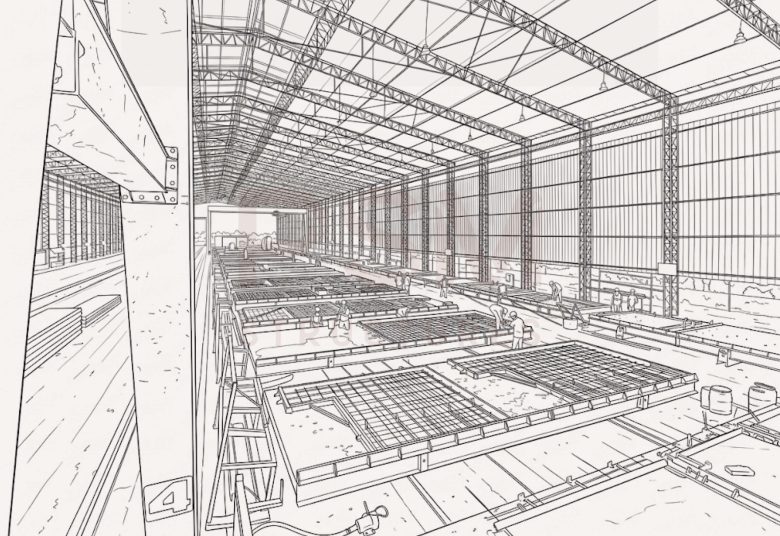
A precast concrete manufacturing plant runs as a sequence of stations, each handing the element to the next. The flow looks very different from a conventional site, where one crew waits on another in the open. In a plant, the work is parallelised and the conditions are fixed.
Inside a Concrete Precast Plant: Station by Station
A modern concrete precast plant is organised around the path an element takes from raw material to finished, stored product:
- Batching and mixing. Aggregates, cement, water, and admixtures are weighed automatically and mixed to a designed proportion. Automated batching is what gives a precast plant its consistency; the mix that goes into the first element is the mix that goes into the thousandth.
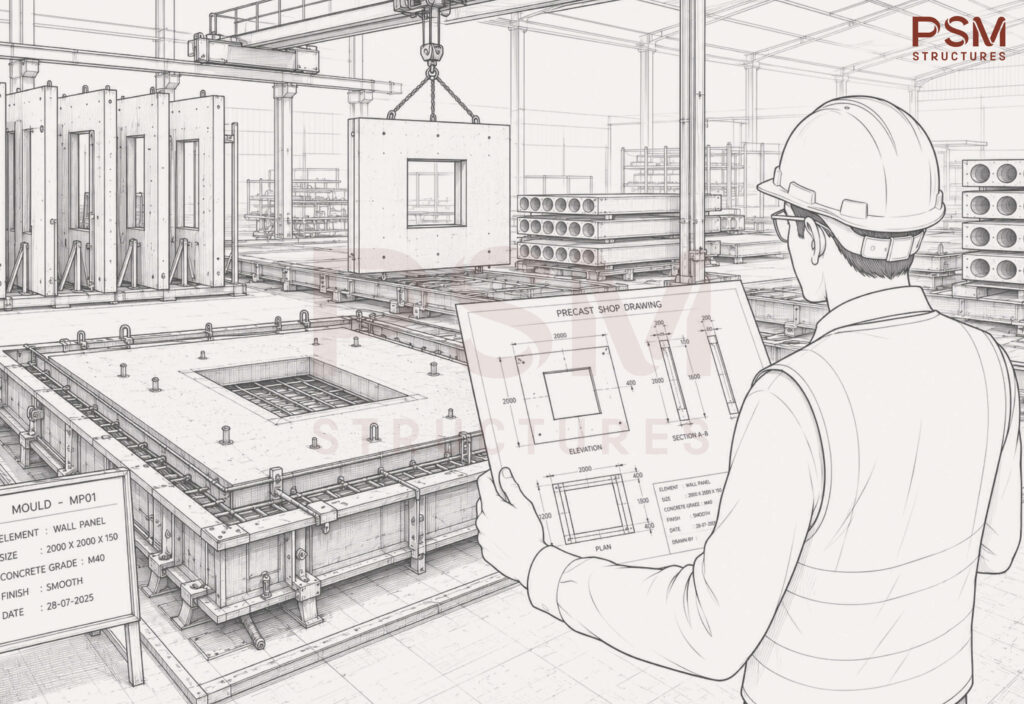
- Mould preparation. Steel or composite moulds are cleaned, oiled, and set to the exact dimensions of the element, with openings for doors, windows, and services positioned to drawing.
- Reinforcement and inserts. Rebar cages, mesh, lifting hooks, and cast-in connection inserts are placed in the mould before the pour. In prestressed elements, strands are tensioned at this stage.
- Casting and compaction. Concrete is poured and compacted, usually by vibration, to remove air voids. Proper compaction is what produces the dense, durable surface precast is known for.
- Curing. The element is cured, often with controlled heat or steam, so it reaches handling strength in hours rather than days. Curing control is where a precast concrete manufacturing plant earns its quality advantage over a site pour.
- Demoulding, finishing, and QA. The element is lifted from the mould, finished, inspected against tolerance, and signed off by the plant's quality team.
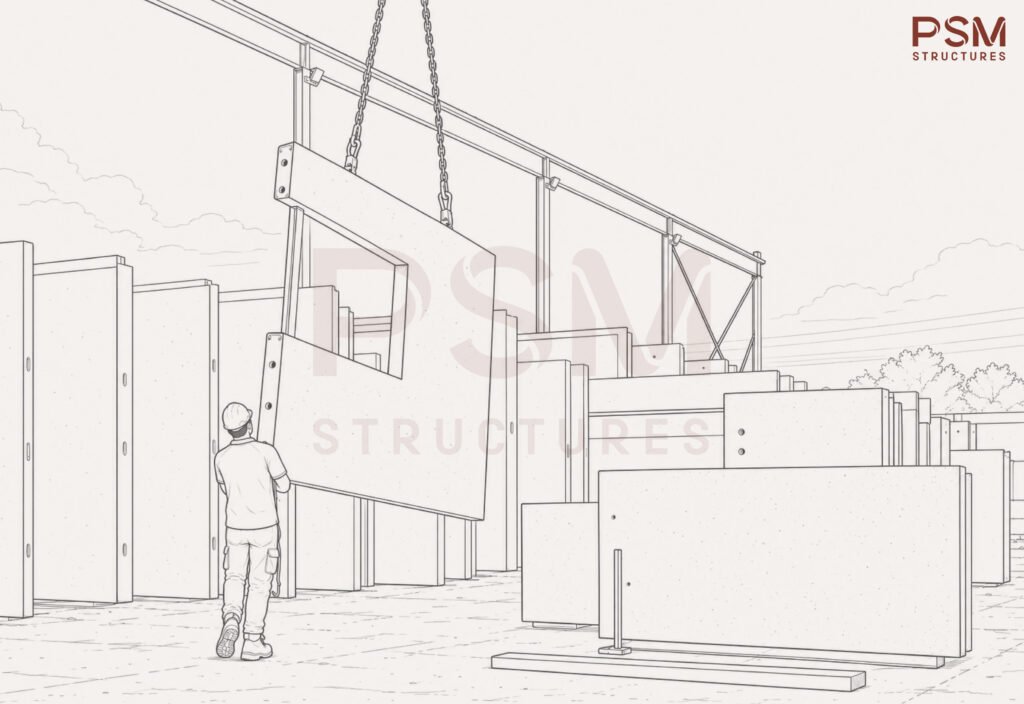
- Storage and dispatch. Finished elements are stacked in the storage yard on proper supports, then loaded for transport in the sequence the site needs them.
The whole line depends on coordination. A precast concrete manufacturing plant that batches well but cures poorly, or casts accurately but stores carelessly, undoes its own work. The strength of the plant is the strength of its weakest station.
Assessing a precast plant for an upcoming project?
PSM Structures works with EPC contractors and developers on precast scope, plant capability assessment, and structural design from the earliest stage of the project brief.
Discuss Your Project →Types of Precast Concrete Plants
Not all precast concrete plants are built the same way. The right type depends on the product mix, the volume, and the project location.
Stationary vs Mobile Precast Plant
A stationary precast plant is a permanent facility with fixed casting beds, overhead cranes, curing chambers, and a storage yard. It serves many projects across a region and amortises its setup cost across years of output. Most serious precast supply in India comes from stationary plants.
A mobile or site precast plant is set up temporarily at or near a large project, casting elements close to where they are erected to cut transport cost and handling damage on very large or very remote jobs. A site precast plant makes sense when the project volume is large enough to justify standing up a temporary facility and transport distance from a stationary plant would otherwise dominate the cost.
Wet-Cast vs Dry-Cast Plants
Wet-cast plants use a higher-water-content, flowable mix poured into moulds, suited to structural and architectural elements where surface finish and strength matter, columns, beams, wall panels, stairs. Dry-cast plants use a stiff, low-water mix compacted by machine, suited to high-volume repetitive products such as pipes, blocks, and pavers. Most structural precast for buildings and infrastructure comes from wet-cast precast concrete plants.
Automated Carousel vs Long-Line Bed
High-volume precast concrete plants for wall panels and slabs often use an automated carousel, where moulds circulate between stations on a controlled cycle. Elements with long, repeating geometry, such as prestressed beams and hollow-core slabs, are cast on long-line beds. The plant layout signals what a manufacturer is built to produce efficiently and what it is not.
| Plant type | Best suited to | Typical products |
|---|---|---|
| Stationary, wet-cast | Structural and architectural elements at volume | Columns, beams, wall panels, stairs |
| Site / mobile | Very large or remote single projects | Bulk repeating elements cast near erection |
| Dry-cast | High-volume repetitive products | Pipes, blocks, pavers |
| Carousel-automated | Repetitive panels and slabs at scale | Wall panels, solid and sandwich panels |
| Long-line bed | Prestressed long-span elements | Beams, hollow-core and double-tee slabs |
What a Strong Precast Concrete Manufacturing Plant Must Have
The plant tour tells you more than the brochure. A capable precast concrete manufacturing plant carries a recognisable set of capabilities:
- Automated batching with a testing lab. Computerised batching plus an on-site lab that tests cube strength, slump, and aggregate quality on every production run.
- Controlled curing. A defined curing regime, often steam or controlled heat, not elements left to cure wherever there is space.
- Adequate handling capacity. Overhead and yard cranes rated for the heaviest element, with safe lifting points designed into every piece.
- A real storage yard. Elements stored on correct supports in dispatch sequence, not stacked in a way that bows or cracks them before they ship.
- Documented quality control to code. Production and erection to IS 15916 and concrete to IS 456, with inspection records that travel with the elements.
- Connection engineering. The detailing of joints and cast-in inserts, where precast structures succeed or fail over a 30-year life, handled in-house rather than left to site improvisation.
Decision factor: A plant that is strong on casting but weak on curing, handling, or storage will still send out elements that disappoint on site. The capability has to be complete.
How to Evaluate Precast Concrete Plant Manufacturers
Searching for precast concrete plant manufacturers returns two very different kinds of company: those that sell batch-plant machinery, and those that operate a plant and supply finished precast to projects. For a project buyer, the second group matters. The question is not who has the biggest plant, but whose plant can deliver your elements, to tolerance, on your programme.
When evaluating precast concrete plant manufacturers, ask:
- What is the real production capacity, in elements or square metres per month, and what is committed to other projects? Capacity on paper is not capacity available to you.
- What is the quality regime? Ask to see the batching control, the testing lab, the curing method, and the inspection records.
- Which codes do they design and produce to? IS 15916 for precast design and erection, IS 456 for concrete, and the relevant load and seismic codes.
- Who does the connection detailing? The joints are the structural risk; the answer should be an in-house engineering team, not the site.
- What is the transport distance and the dispatch plan? A capable plant sequences elements to the erection programme; distance drives both cost and handling damage.
- Can they show completed projects of similar type and scale from the same plant? Photographs of a plant are not evidence; delivered structures are.
Decision factor: The strongest precast concrete plant manufacturers answer these without hesitation, because the answers are how they win serious work. A vague answer on capacity, curing, or connection detailing is the warning sign.
Precast Concrete Plants in India: Market Context
India's precast concrete plants have moved from a handful of specialist facilities to a growing national base, driven by infrastructure spending, industrial and warehouse construction, affordable housing programmes, and the labour and quality pressures that push projects off the wet-site model. Stationary precast concrete plants now serve metro, logistics, industrial, and residential work across most regions, and the capability gap between a basic yard and an engineered, automated plant is widening.
For a buyer, that maturing market is good news and a caution at once. There are more precast concrete plants to choose from, and a wider quality spread between them. The plant that wins a project on price but lacks the curing control, handling capacity, or connection engineering to deliver is where precast gets unfairly blamed for outcomes that were really a plant-selection failure. The method is sound; the plant has to match it.
PSM Structures applies the same plant-led thinking across project types, from precast for cold storage and logistics parks to the PEB versus precast decision for industrial buildings and precast concrete homes.
Buyers scrutinise the design and the price, then take the plant on trust. It should be the other way round. The curing regime, the handling discipline, and the connection detailing inside the plant decide whether an element performs for 30 years. Tour the plant, ask about capacity and curing, and find out who details the connections. That conversation tells you more than any brochure.
Parv Modh
Choosing the right precast partner from the start
PSM Structures advises EPC contractors and developers on precast scope, plant capability, and structural design sequencing, at the stage where the decision actually protects cost and programme.
Talk to the Team →Precast Concrete Plant: Frequently Asked Questions
A precast concrete plant is a factory that casts concrete elements, columns, beams, wall panels, slabs, and stairs, in reusable moulds under controlled conditions, then cures them to strength before transport to site. The controlled environment lets the plant guarantee mix quality, dimensional accuracy, and curing in a way a conventional open site cannot.
A precast concrete manufacturing plant runs as a sequence of stations: automated batching and mixing, mould preparation, reinforcement and insert placement, casting and compaction, controlled curing, demoulding and quality inspection, then storage and dispatch. Each station hands the element to the next, and the curing stage is what gives the plant its quality advantage over a site pour.
The main types of precast concrete plants are stationary plants, which are permanent regional facilities, and mobile or site plants set up temporarily for very large or remote projects. Plants are also categorised as wet-cast, for structural and architectural elements, or dry-cast, for high-volume products like pipes and blocks, and by layout as automated carousel lines or long-line casting beds.
A stationary precast plant is a permanent facility with fixed casting beds, cranes, curing chambers, and a storage yard that serves many projects over years. A mobile or site precast plant is set up temporarily at or near a single large project to cut transport cost and handling damage. Most precast supply in India comes from stationary plants.
A concrete precast plant controls quality through automated batching, an on-site testing lab that checks cube strength and slump on every run, a defined curing regime, dimensional inspection against tolerance before dispatch, and production to codes such as IS 15916 and IS 456. Inspection records travel with the elements to site.
Evaluate precast concrete plant manufacturers on real available production capacity, the quality regime (batching, testing lab, curing), the codes they produce to, who does the connection detailing, the transport and dispatch plan, and completed projects of similar scale from the same plant. Clear answers on capacity, curing, and connections separate capable manufacturers from the rest.
Setting up a precast concrete plant in India varies widely with capacity and automation, from a basic mechanised yard to a highly automated carousel facility, so the investment ranges from modest to substantial. For most project buyers the relevant question is not the setup cost but whether an existing plant has the capacity, quality regime, and engineering to deliver their elements on programme.