Table of Contents

The PEB vs precast debate comes up on almost every significant industrial construction project in India. EPC contractors get asked to recommend one. Developers want to know which delivers the better schedule. Project managers want to know which costs less. The honest answer is that both systems are correct — but for different reasons, on different projects, and the wrong choice at the wrong stage causes exactly the kind of delays and cost overruns that get blamed on the structural system rather than the decision-making process.
This article covers both systems technically, compares them across the factors that actually matter to industrial project teams, and gives a clear framework for deciding which one fits a given project.
What Is a Pre-Engineered Building (PEB)?
A pre-engineered building (PEB) is a steel structural system designed, fabricated in a factory, and erected on site. The primary frame consists of tapered I-section columns and rafters connected with high-strength bolts. Purlins and girts carry the roof and wall cladding. The entire system is software-optimised to minimise steel tonnage for a given span and load combination.
PEB is not the same as a conventional steel structure. A conventional steel structure uses standard rolled sections (UB, UC, ISA angles) and is designed and fabricated locally. PEB uses custom-tapered sections designed and fabricated by the manufacturer — companies such as Kirby, Interarch, Pennar, Zamil, and BlueScope — and erected by their own authorised teams. The distinction matters because PEB's speed and cost advantages come specifically from that factory optimisation and the manufacturer's integrated erection system. A locally fabricated steel structure built to resemble PEB does not deliver the same outcome.
What PEB delivers well:
- Long clear spans — up to 90m without intermediate columns
- Fast erection — a medium warehouse frame is typically up in 8-12 weeks from delivery
- Light self-weight, which reduces foundation loads and cost on normal soils
- Flexibility to add lean-to extensions and mezzanines later
- Lower structural cost per square metre on large, simple footprints
Where PEB has structural limits:
- Susceptible to differential settlement — column base plates need accurate, well-cured pedestals
- Thermal expansion requires careful detailing in long buildings (expansion joints every 80-100m)
- Corrosion protection is an ongoing maintenance responsibility across the building's life
- Acoustic and thermal performance depends entirely on the cladding system chosen
- Not suited to heavy overhead crane loads above approximately 10 MT without significant frame upgrades
What Precast Concrete Delivers for Industrial Buildings
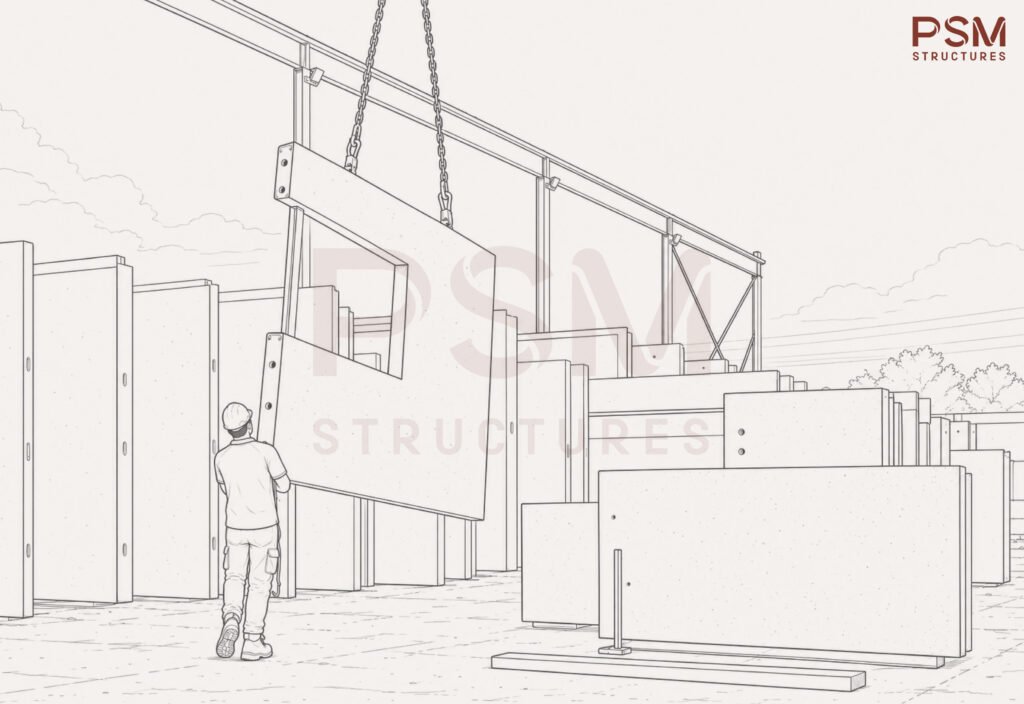
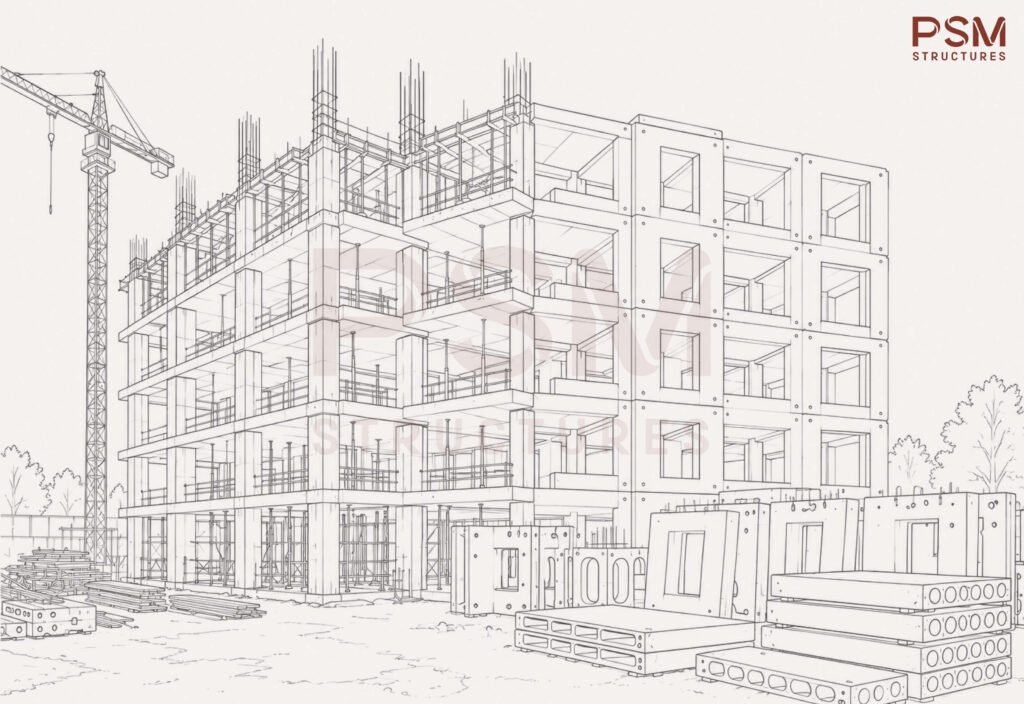
Precast concrete structural systems use factory-cast columns, beams, floor slabs, and wall panels transported to site and assembled using cranes. In the Indian industrial market, the most common precast applications are columns and long-span beams for the primary frame, hollow core slabs or double-tee slabs for floors and roofs, and insulated wall panels for cold storage and processing facilities.
Factory casting gives precast consistent quality control — mix design, reinforcement placement, and curing conditions are controlled to a standard that cast-in-situ concrete cannot match at construction speed.
What precast delivers well:
- High compressive strength with tight dimensional tolerances
- Thermal mass — critical for cold storage, food processing, and any temperature-controlled facility
- Fire resistance without additional treatment (concrete is inherently fire-resistant to 2-4 hours at structural grade)
- Heavy crane capacity — precast frames handle overhead cranes of 20 MT and above without frame modifications
- Low long-term maintenance — no corrosion, no repainting, no bolt re-torquing cycles
- Direct integration with insulated panel systems, avoiding the thermal bridging that arises at steel cladding connections
Where precast has structural limits:
- Heavier than steel — foundation design is more substantial and more costly
- Less forgiving of layout changes after the structural grid is fixed — connection geometry is designed and cast, not bolted
- Requires accurate crane access planning during construction — large elements need clear crane paths through the site
- Longer factory lead time on bespoke elements, typically 8-12 weeks from order to delivery
Evaluating the structural system for an industrial project?
PSM Structures works with EPC contractors and developers on structural method selection, civil package scope, and precast design from the earliest stage of the project brief.
Discuss Your Project Brief →PEB vs Precast Concrete: The Structural Comparison
Span Capability: PEB vs Precast Concrete
Both systems handle 20-40m clear spans without intermediate columns, which covers most standard warehouse and industrial shed requirements. Beyond 40m, PEB has a practical advantage — it reaches 90m spans economically with standard fabrication. Precast long-span beams are available up to approximately 30-35m in the Indian market; beyond that, element weight and transportation logistics become limiting factors.
Decision factor: For clear spans above 40m — aircraft hangars, large assembly halls, bulk storage with unobstructed floor areas — PEB is the more practical structural choice.
Construction Schedule: PEB vs Precast
This is where the comparison is most often misread. PEB is frequently described as faster than precast. On a greenfield site with no constraints, that is roughly true for superstructure erection only. But total project schedule depends on far more than superstructure.
PEB requires accurate column pedestal construction before erection begins. If the civil work is not complete and properly levelled, erection cannot start. Precast also requires accurate foundations, but the frame goes up quickly once civil work is done. Factory production for both systems can run in parallel with site preparation — which is the normal situation in industrial park development. When the site is being prepared alongside factory production, the difference in total structural schedule between PEB and precast narrows considerably.
Decision factor: The real determinant of programme is how well the civil groundwork and factory production are coordinated, not which system is used. For more on sequencing the civil package correctly, see the precast civil package guide for cold storage and logistics parks.
PEB vs Precast Concrete Cost Comparison
On a pure structural cost per square metre, PEB is generally less expensive for simple, large-footprint industrial buildings on normal soils. The steel tonnage optimisation and the manufacturer's erection system reduce cost on straightforward projects.
Precast costs more per square metre for the structure itself but often costs less on the total project when:
- The building requires insulated panels — precast delivers structure and insulation together; a PEB structure still needs insulated cladding as a separate trade
- The site has aggressive soil or groundwater conditions — concrete durability reduces the lifecycle cost of a corrosion-prone steel frame
- Overhead cranes above 10 MT are part of the brief — precast avoids the frame upgrade cost a PEB requires at that load level
- The project has multiple repeating bays with standardised geometry — mould costs amortise quickly across repetition
Decision factor: The structural cost line is rarely where the real difference sits. A full project cost model — including foundations, cladding, crane infrastructure, and 20-year maintenance — gives a more honest comparison than comparing structural tonnage alone.
Durability and Lifecycle Cost: Precast Concrete vs PEB
A PEB building with consistent cladding maintenance lasts 30-40 years without major structural intervention. The steel frame requires periodic inspection, repainting, and bolt re-torquing. In coastal, humid, or chemically aggressive environments — ports, chemical plants, fertiliser facilities — the corrosion maintenance cost is a significant lifecycle consideration that the initial structural cost comparison does not capture.
A precast concrete frame, properly designed and cast, has a design life of 50+ years with minimal structural maintenance. The concrete does not corrode. In aggressive environments, the lifetime cost difference between a concrete and a steel frame is often significant enough to change the initial budget decision.
Decision factor: For any facility in a corrosive environment or with a long design life requirement, precast carries a structural durability advantage that the upfront cost comparison does not reflect.
Heavy Crane Capacity: Precast Concrete vs PEB
This is the clearest differentiator between the two systems. Industrial facilities with overhead cranes above 10 MT — steel processing plants, heavy fabrication shops, automotive assembly, large precast factories — require a structural frame capable of handling crane beam loads and the dynamic forces generated during operation.
PEB can accommodate cranes, but the frame typically requires significant reinforcement at that load level, which erodes both the cost and speed advantages. Precast concrete columns and crane beams handle heavy crane loads as a standard engineering solution — no upgrade, no additional cost line.
Decision factor: For heavy crane applications, precast is structurally better suited without the modifications a PEB requires.
| Factor | PEB | Precast Concrete |
|---|---|---|
| Maximum clear span | Up to 90m | Up to 30-35m (beams) |
| Structural cost (simple shed) | Lower per sqm | Higher per sqm |
| Heavy crane capacity (>10 MT) | Requires frame upgrade | Standard solution |
| Thermal mass | None (cladding-dependent) | High |
| Corrosion resistance | Maintenance required | Inherent |
| Fire resistance | Cladding-dependent | 2-4 hours inherent |
| Design life | 30-40 years | 50+ years |
| Multi-storey capability | No | Yes |
When to Choose PEB for Industrial Construction
- Simple warehouse or logistics shed, single or multi-bay, spans under 40m
- Budget-sensitive project on a good soil profile with no groundwater complications
- Project where long-term maintenance responsibility sits with an active facilities team
- Fast-turnaround requirement with a straightforward structural brief and no special process requirements
- Buildings where the thermal and acoustic performance is handled entirely by the cladding system
When Precast Concrete Is the Right Structural Choice
- Cold storage, food processing, pharmaceutical — any facility requiring thermal mass or hygiene-grade wall panels
- Overhead cranes rated at 10 MT and above
- Projects in corrosive, coastal, or chemically aggressive environments
- Long design life (40+ years) or a low-maintenance operational requirement
- Multi-storey industrial facilities or car parks — precast floor slabs carry loads that PEB does not accommodate
- Facilities with repeating structural bays where mould amortisation reduces unit cost per element
How to Choose Between PEB and Precast for Your Industrial Project
Three questions resolve most PEB versus precast decisions before a detailed structural comparison is needed:
1. What are the overhead crane loads?
If overhead cranes above 10 MT are specified, precast is the structurally correct starting point. The cost of upgrading a PEB frame to handle that load typically eliminates any cost advantage the steel system would otherwise have.
2. What is the thermal brief?
Temperature-controlled facilities — cold storage, clean rooms, food processing, pharmaceutical — are almost always precast. The insulated panel system integrates with the structural frame in a way that steel cladding cannot replicate without thermal bridging.
3. What is the site environment?
Coastal proximity, high groundwater salinity, or chemically aggressive industrial neighbours all tilt the lifecycle analysis toward precast. The concrete frame does not require the maintenance that a steel frame does in those conditions.
If all three answers point toward a standard unconditioned warehouse with no heavy cranes on a dry inland site, PEB is typically the more cost-effective structural choice. If any one of those three questions pushes toward concrete, the structural, lifecycle, and coordination case for precast becomes difficult to argue against on the numbers alone.
A late switch between structural systems — from PEB to precast or the reverse — almost always loses the schedule advantage it was intended to save. The time to make the structural decision is during design, before the grid is locked and the factory lead time has started.
The PEB versus precast decision is made too late on too many projects. By the time the structural brief is finalised, the factory lead time is already compromised. Lock the structural method during design, before the civil works begin. That is the only stage where the choice actually saves time and cost.
Parv Modh
Getting the structural method right from the start
PSM Structures advises EPC contractors and industrial developers on structural system selection, precast civil package scope, and design sequencing — at the stage where the decision actually saves time and cost.
Talk to the Team →PEB vs Precast Concrete: Frequently Asked Questions
For simple, large-footprint warehouses on normal soils, PEB is usually lower structural cost per square metre. The full project cost comparison — including foundations, cladding, crane infrastructure, and lifecycle maintenance — often narrows or reverses that gap. A total cost model gives a more honest answer than a structural-only comparison.
PEB superstructure erection is fast once foundations are ready. Precast has a similar site installation speed once factory production is complete. On most industrial projects, both systems run factory production in parallel with site preparation, and the difference in total programme is small. The real determinant is how well the civil groundwork and factory delivery are coordinated.
PEB handles light to medium cranes, up to approximately 10 MT, as a standard design. Cranes above 10 MT typically require frame reinforcement that adds cost and reduces the speed advantage of the PEB system. Precast concrete columns and crane beams handle heavy crane loads as a standard structural solution without modification.
Cold storage requires thermal mass, hygiene-grade wall panels, and tight dimensional tolerances for insulated panel installation. Precast integrates directly with insulated panel systems, provides thermal mass, and eliminates the thermal bridging that arises at steel cladding interfaces. Most purpose-built cold storage facilities above 5,000 sqm in India use precast civil packages.
Yes. Hybrid structures using precast columns and crane beams with a PEB roof system are used on some heavy industrial projects where crane loads require concrete but the clear-span roof is more economically done in steel. This approach adds coordination complexity between two structural systems and two erection sequences, and should be specified deliberately based on the structural brief.
Precast concrete has lower structural maintenance costs over the building's life. There is no corrosion, no repainting schedule, and no bolt re-torquing requirement. PEB requires inspection and maintenance of the steel frame at intervals, particularly in humid, coastal, or chemically aggressive environments. For facilities with 30-year-plus design lives, the lifecycle cost comparison often favours precast even when the upfront structural cost is higher.
Yes. Precast concrete is the standard structural system for multi-storey industrial buildings, car parks, and any application requiring floor slabs that carry heavy distributed or point loads. PEB is a single-storey structural system by design and does not accommodate floor loads in a multi-storey arrangement.