Table of Contents
Your solar panels are installed. Your inverters are in. The modules are gleaming across hectares of Rajasthan flatland. And your plant still cannot go live, because the ICR is not ready.
This situation plays out on solar sites across India more often than anyone in the industry likes to admit. The Inverter Control Room sits squarely on the critical path of every solar project, and yet civil construction teams consistently treat it like an afterthought. The result is delayed commissioning, lost generation revenue, and penalty clauses that eat into margins that were already tight.
India has set an ambitious target of 500 GW of renewable energy capacity by 2030, with solar accounting for the majority of that growth. As of early 2025, [India’s installed solar capacity crossed 90 GW](https://www.mercom india.com/india-solar-installation-q4-2024/), meaning hundreds of utility-scale plants are in various stages of design, construction, and commissioning right now. The pace of development is accelerating. Civil infrastructure that cannot keep up is no longer just a project-level problem, it is an industry-level one.
What is an ICR in a Solar Plant?
ICR stands for Inverter Control Room. It is the nerve centre of a solar plant, the structure that houses the string or central inverters, protection and control panels, communication systems, and the cable management infrastructure that connects the DC field to the AC grid.
In terms of plant layout, the ICR sits between the inverter blocks and the grid connection point. On utility-scale projects, you typically have multiple ICR units distributed across the plant, one per MW block or per defined capacity zone, each feeding into the main switchyard.
What makes the ICR in a solar plant so critical is its position on the project schedule. Electrical commissioning cannot begin until the ICR structure is complete, weatherproofed, and cleared for equipment installation. That means civil delays on the ICR directly translate into delays across the entire plant. It is not one item on a long list, it is the bottleneck.
According to a McKinsey Global Institute report on construction productivity, large construction projects across sectors typically run 80% over schedule and 20% over budget, and infrastructure projects in emerging markets face even greater variance. Solar civil works are not immune to this pattern.
ICR sizes vary based on plant capacity and inverter configuration. For large-scale projects, a standard precast ICR unit typically measures 12m x 6m or larger, with cable entry points, ventilation provisions, and equipment mounting systems all built into the structural design.
The ICR also connects directly to the Inverter Duty Transformer and feeds into the switchyard infrastructure, meaning any misalignment in the civil structure creates coordination problems downstream.
Conventional ICR Construction vs Precast Solar ICR
The gap between conventional ICR construction and a precast solar ICR comes down to one word: certainty.
Conventional ICR Constructions
Conventional on-site construction starts with locally sourced materials, a civil gang, and a schedule that assumes everything goes right. In practice, it rarely does. Concrete is poured in batches, quality varies between pours, and curing time alone adds two to three weeks to the programme, regardless of what else is happening on site. The weather disrupts the pour schedule. The water table causes formwork issues. Rebar placement errors get discovered late. And because the ICR is being built by a civil subcontractor who answers to the main EPC contractor, who answers to the developer, accountability gets diffused across every link in that chain.
The World Economic Forum estimates that the construction industry wastes up to 30% of all materials used on site through inefficiency, rework, and poor planning. For a cost-sensitive sector like solar EPC, that waste is simply not acceptable.
Precast Solar ICR
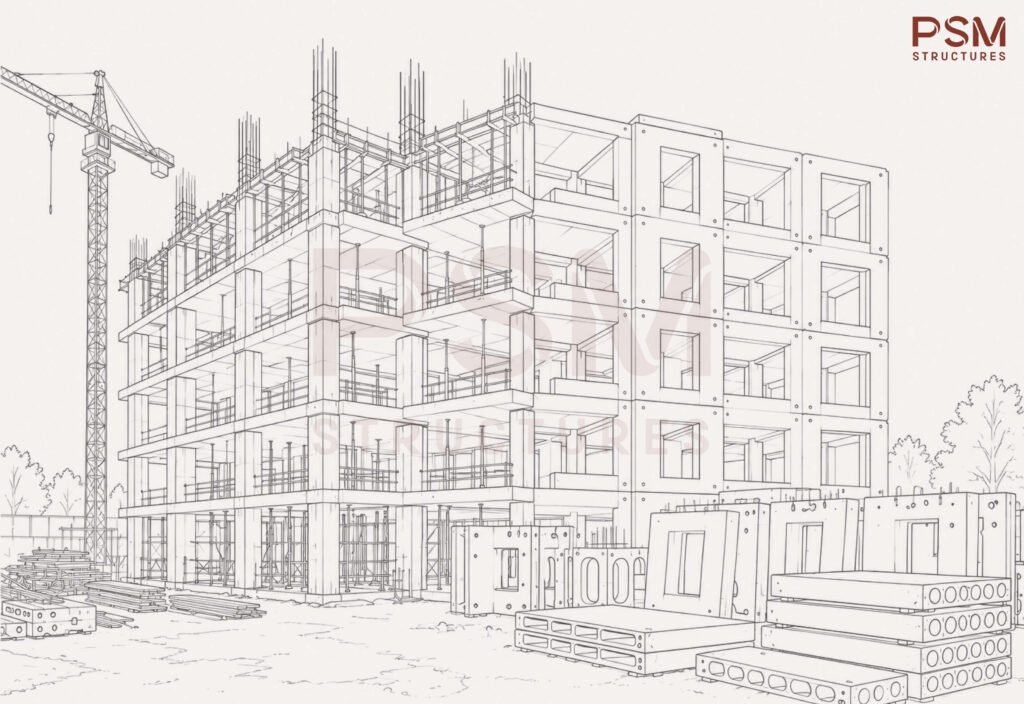
A precast solar ICR is engineered and cast in a controlled factory environment before site work even begins. Structural members, columns, beams, wall panels, and staircase units are manufactured to exact BIM-derived specifications. M35 concrete is used throughout. Reinforcement is TMT Fe500 steel. Anchor bolt positions, grouting tube locations, cable entry openings, all pre-positioned to match the electrical GA drawings. When the structure arrives on site, it goes up in days, not weeks.
Research by the Precast/Prestressed Concrete Institute shows that precast construction methods can reduce overall project schedules by up to 60% compared to conventional cast-in-situ methods, a figure consistent with what PSM Structures delivers on solar projects across India.
The difference is not just speed. It is the elimination of variables. Every dimension has been checked in 3D before casting. Every component has been quality-checked before dispatch. There are no surprises on site because every decision was made at the drawing stage.
For EPC contractors working against tight commissioning windows, that certainty is worth more than any per-unit cost saving.
PSM offers precast solutions that support solar and BESS EPC contractors
Key Components of a Precast ICR Structure
A well-designed precast ICR is not a simple box. Here is what goes into a properly engineered precast ICR structure:
Foundation system
Isolated footings, typically 1550 x 1550 x 350mm, with tie beams connecting column bases. PCC bed laid below the footing level. Foundation depth set to SBC requirements based on geotechnical data.
Column and beam system
Precast columns with corbels for beam seating. PB 300 x 600mm beams spanning between column lines. Column-beam connections designed for seismic loads per IS codes.
Anchor bolt system
M24 high-strength anchor bolts, Grade 8.8, with grouting tubes for post-installation grouting. Base plates 250 x 250 x 16mm thick. This is where most on-site builds fail; anchor bolt misalignment is one of the most common and most expensive civil errors on solar projects.
Cable management
Openings pre-formed in floor slabs and wall panels to match approved electrical routing drawings. No cutting on site. No structural compromise after the fact.
Staircase
Precast staircase units, factory-made, site-assembled, with corner protection details and handrail provisions built into the design.
Surface finish
Concrete cover maintained at 40mm for foundations, 30mm for columns, 25mm for beams, 20mm for slabs, all per IS:456:2000.
Every component is designed together, fabricated together, and delivered as a coordinated system.
Why a Precast ICR Directly Impacts Your Commissioning Date
Here is the business case, plainly stated.
A conventional ICR in a solar plant takes six to ten weeks to construct on site — from excavation to structural completion to electrical readiness. A precast solar ICR, from factory fabrication to site erection, can be completed in two to three weeks, with fabrication running in parallel while foundation work is ongoing at site.
That parallel programme is the real advantage. While your civil team is preparing the ground, PSM’s factory is casting the structure. By the time the foundation is ready, the precast components are on a truck.
The cost of a delayed commissioning date is not abstract. According to CERC tariff benchmarks, a 50 MW solar plant generating at 25% capacity factor produces roughly 30,000 units per day. At ₹3.50 per unit on a typical PPA, that is ₹1,05,000 per day in lost generation revenue — before factoring in EPC penalty clauses, extended equipment hire, and liquidated damages. One week of unnecessary delay on the ICR costs more than the entire premium of switching to precast.
A 2023 report by the Institute for Energy Economics and Financial Analysis (IEEFA) noted that civil and grid-related delays remain among the top three causes of commissioning slippage on utility-scale solar projects in India. The ICR, as a civil-electrical interface structure, sits at the intersection of both risk categories.
When you choose a precast ICR, you are not just choosing a construction method. You are buying back time
Precast ICR Built for India's Solar Scale
Every solar plant has a commissioning date. That date is backed by a PPA, a penalty clause, and months of investor expectation. When civil work on the ICR in a solar plant slips, everything else slips with it.
With India needing to add an average of 50 GW of solar capacity per year to meet its 2030 targets, the margin for civil delays is shrinking. EPC contractors who solve the civil bottleneck now will be the ones winning projects as the market scales.
Precast ICR construction does not just save time — it gives you back control. Factory precision, parallel fabrication, and single-point accountability mean your structure is ready when your plant is ready.
PSM Structures builds precast ICR and every civil structure your solar plant needs — from foundations to substations — with the engineering rigour and project experience to back it up.
Ready to take civil delays off your critical path?
FAQs About Precast in Solar EPCs
ICR stands for Inverter Control Room. It is the structure that houses the inverters, control panels, and cable management systems that connect the DC solar field to the AC grid. The ICR in a solar plant sits on the critical path of the project schedule — commissioning cannot begin until it is complete.
A conventional ICR is built on-site using cast-in-situ concrete, which takes six to ten weeks and is subject to quality variance, weather delays, and labour availability. A precast ICR is factory-manufactured to precise specifications and assembled on site in days. The precast solar ICR also benefits from BIM-integrated design, which eliminates coordination errors before fabrication begins.
From factory dispatch to site erection, a precast solar ICR can be fully assembled in three to five working days depending on the number of units and site conditions. Factory fabrication runs in parallel with site preparation, so the overall programme impact is significantly lower than conventional construction. Read more about the benefits of precast civil structures for solar EPC
ICR sizing depends on your plant's inverter configuration and capacity per block. On utility-scale projects, a standard precast ICR unit typically covers one inverter block. PSM's engineering team will size and design the ICR based on your approved electrical GA drawings. Contact us with your project details