Table of Contents
India’s industrial sector is expanding at a pace that demands infrastructure to match. The Ministry of Commerce and Industry reports that India attracted over $70 billion in FDI in 2023-24, with manufacturing, logistics, and warehousing among the top receiving sectors. Every one of these facilities needs built space, and they need it fast.
The industrial shed is the backbone of this infrastructure. From manufacturing units and warehouses to logistics hubs and solar plant ancillary buildings, industrial sheds are going up across the country at scale. The question is no longer whether to build, it is how to build faster, stronger, and more cost-effectively than the project before it.
Precast industrial shed construction is the answer that India’s most forward-thinking developers and EPC contractors are arriving at. This guide covers everything you need to know: what an industrial shed is, how precast construction works, what drives cost, and how PSM Structures delivers turnkey precast industrial sheds across India.
What is an Industrial Shed?
An industrial shed is a large-span structural building designed for industrial, manufacturing, warehousing, storage, or operational use. Unlike commercial buildings, industrial sheds are designed around function, clear internal spans, high floor-to-ceiling heights, heavy floor loading capacity, and minimal internal columns that would obstruct operations.
The structural system typically consists of a column and beam framework supporting a roof system, with wall panels or cladding completing the envelope. The design varies significantly based on use; a warehouse handling palletised goods has different structural requirements than a manufacturing unit running overhead cranes or a solar plant equipment room housing high-voltage systems.
What makes industrial shed design critical is the range of loads the structure must handle: dead loads, live loads, wind loads, equipment loads, and, in some cases, crane loads. Getting the structural design right from the start determines whether the building performs safely and efficiently for its entire operational life.
Types of Industrial Shed Construction Methods
Not all industrial shed construction methods are equal. Three main approaches dominate the Indian market today, each with distinct advantages and trade-offs.
Cast-in-situ RCC construction
Builds the entire structure on site, columns, beams, slabs, and walls poured in sequence. Quality depends heavily on site conditions, labour skill, and weather. Curing time alone adds weeks to the programme. Material waste is high and schedule predictability is low.
The World Economic Forum estimates that the construction industry wastes up to 30% of all materials used on site through inefficiency, rework, and poor planning. For a cost-sensitive sector like solar EPC, that waste is simply not acceptable.
Prefabricated steel sheds
These use factory-made steel sections that are bolted together on site. They are fast to erect and relatively lightweight. However, steel is susceptible to corrosion in humid, coastal, or chemically active environments and requires ongoing maintenance, repainting, rust treatment, and periodic structural inspection over its operational life.
Precast RCC industrial sheds
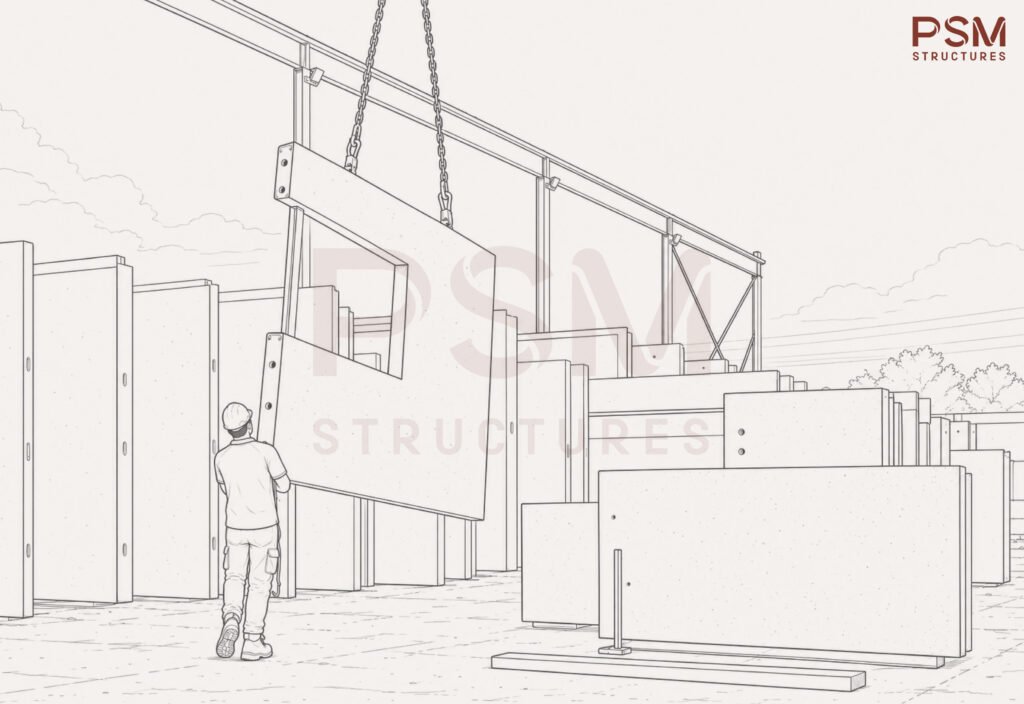
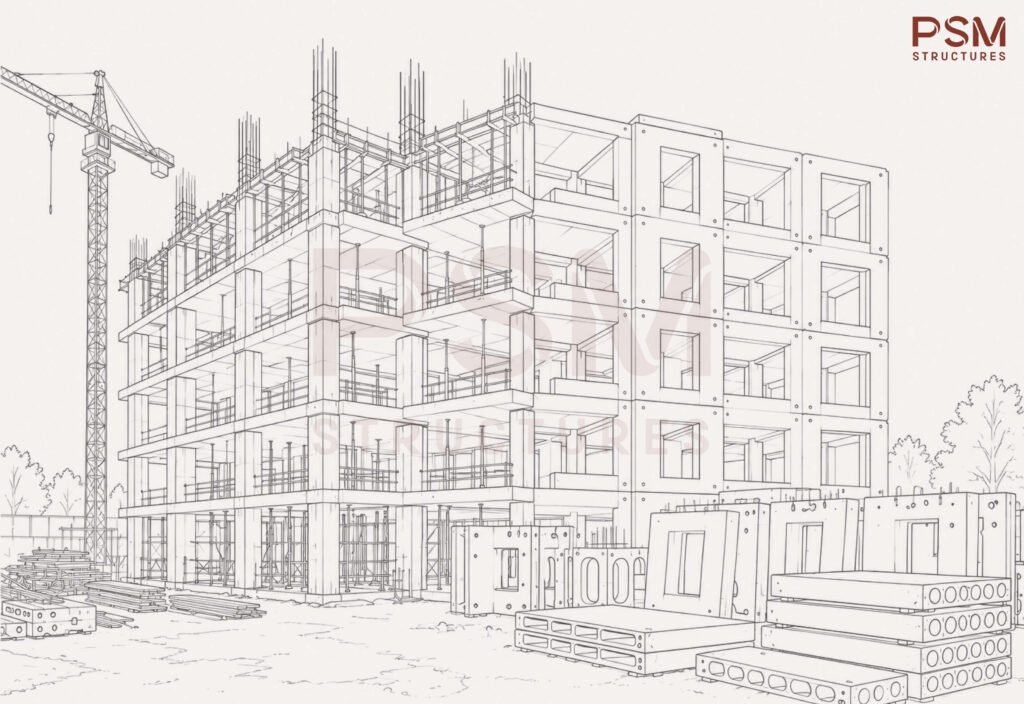
This combines the structural strength of reinforced concrete with the speed and precision of factory fabrication. Columns, beams, wall panels, and roof elements are cast in a controlled factory environment and assembled on site. The result is a permanent, low-maintenance structure that handles heavy industrial loads, resists fire and corrosion, and performs reliably for decades.
For industrial applications that demand structural strength, long spans, and low lifetime cost, precast is the construction method worth understanding in detail.
PSM delivers precast industrial sheds, ICR structures, substations, and more, all under one contract.
Industrial Shed Design: What Goes Into a Well-Engineered Structure
Good industrial shed design is not just about putting up four walls and a roof. It is an engineering exercise that begins well before a single component is cast.
At PSM Structures, every precast industrial shed design starts with a detailed brief — operational use, equipment layout, floor loading requirements, overhead handling needs, and site-specific data including soil conditions and seismic zone classification.
From that brief, the structural design covers:
Column grid and bay layout
Spacing is determined by operational span requirements. Wider bays mean fewer internal columns and more usable floor space, but require heavier structural members. The right balance is project-specific.
Foundation system
Isolated footings, raft foundations, or pile foundations — the choice depends on soil bearing capacity and structural loads. Foundation design is confirmed against geotechnical data before fabrication begins.
Roof system
Roof slope, purlin design, drainage provisions, and roofing material are all resolved at design stage. Natural light and ventilation openings are coordinated with the structural layout.
Wall panel system
Precast wall panels, partial walls with cladding, or open-sided structures, the envelope is designed around operational and environmental requirements.
MEP provisions
Cable ducts, conduit routes, drainage points, and equipment anchor provisions are all built into the precast design, eliminating the need for core-drilling and structural modifications after erection.
BIM integration
PSM uses BIM throughout the design process. Every component is modelled in 3D, clashes are resolved before fabrication, and drawings are issued with full dimensional accuracy. What gets built matches what was designed, every time.
All structures are designed to IS:456:2000 for concrete and IS:1786 for reinforcement steel, with seismic provisions per the relevant IS codes for the project location.
Prefabricated vs Precast Industrial Shed: Understanding the Difference
The terms prefabricated and precast are often used interchangeably. They are not the same thing, and the difference matters when you are making a long-term infrastructure decision.
A prefabricated industrial shed typically refers to a pre-engineered steel structure — light gauge or heavy steel sections fabricated in a factory and bolted together on site. Fast to erect, relatively low upfront cost, and widely available. For temporary facilities or light-use structures, prefab steel sheds are a practical option.
A precast industrial shed uses reinforced concrete components — columns, beams, wall panels, and roof elements — factory-cast to precise engineering specifications and assembled on site. The structure is permanent, fire-resistant, corrosion-resistant, and capable of handling the kind of heavy industrial loads that steel sheds are not designed for.
According to the Concrete Sustainability Hub at MIT, concrete structures have a service life of 50 to 100 years with minimal maintenance, compared to steel structures that typically require significant maintenance intervention within 15 to 20 years in tropical and coastal environments.
For permanent industrial facilities handling heavy equipment, chemical exposure, high humidity, or high-temperature operations — a precast industrial shed delivers a significantly lower lifecycle cost than a prefabricated steel alternative.
Small Industrial Shed: Is Precast the Right Choice for Smaller Facilities
A common assumption is that precast construction is only viable at scale. That is not accurate.
Precast is modular by nature. The same engineering rigour, factory precision, and assembly speed that delivers a 10,000 sq metre warehouse applies equally to a 500 sq metre manufacturing unit, a pump house, a transformer room, or a workshop building.
For a small industrial shed, precast offers particular advantages. Site space is often constrained on smaller plots — factory fabrication and rapid on-site assembly minimises the footprint and duration of construction activity. Quality is consistent regardless of project size. And the structure that results is permanent, low-maintenance, and built to the same IS code standards as any large-scale facility.
PSM designs and builds precast sheds for projects of varying scales — from small ancillary industrial buildings to large-span manufacturing and warehousing facilities. The process is the same. The quality is the same. The timeline advantage is the same.
If you are planning a small industrial shed and want a structure that lasts without ongoing maintenance costs, precast is worth serious consideration.
Why Choose PSM Structures for Your Precast Industrial Shed
Most structural contractors hand off the design to someone else, fabricate what they are told, and hope it fits on site. PSM Structures works differently.
Design, fabrication, and erection sit under one roof. The engineer who models your industrial shed in BIM is the same team that casts it in the factory and assembles it on your site. There are no handoffs, no coordination gaps, and no surprises when components arrive.
Every structure PSM builds is IS code compliant, seismic zone specific, and designed around your operational requirements — not a standard template. M35 concrete and TMT Fe500 steel are used throughout. Cover depths, anchor bolt positions, MEP provisions — all resolved before fabrication begins.
PSM delivers precast industrial sheds turnkey across India. One contract. One point of accountability. From the first structural drawing to the day you walk into a completed building.
FAQs About Precast Industrial Sheds
Industrial shed construction cost in India varies based on size, span, foundation requirements, roof specification, and location. Precast industrial sheds deliver cost certainty that conventional construction cannot match — factory fabrication eliminates material waste and labour variability. Contact PSM Structures for a project-specific estimate based on your actual requirements.
A precast industrial shed can be erected on site in a fraction of the time required for conventional cast-in-situ construction. Factory fabrication runs in parallel with site preparation, meaning structural erection typically takes days to a few weeks depending on project scale — compared to months for a conventional build.
A prefabricated industrial shed typically refers to a pre-engineered steel structure. A precast industrial shed uses reinforced concrete components factory-cast to engineering specifications. Precast concrete offers superior durability, fire resistance, corrosion resistance, and lifecycle cost compared to prefabricated steel — particularly for permanent industrial facilities in Indian climatic conditions.
Yes. PSM designs precast sheds for projects of all scales — from small ancillary industrial buildings and pump houses to large-span manufacturing and warehousing facilities. The engineering rigour and quality standards are consistent regardless of project size.
PSM's precast industrial sheds are designed to handle dead loads, live loads, wind loads, equipment loads, and crane loads where required. Load requirements are confirmed at the design stage and built into the structural specification — ensuring the building performs safely for its full operational life.