Table of Contents
If you have managed civil construction on a utility-scale solar project in India, you already know how the story goes. The module mounting structure arrives on time. The inverter skids are ready. And then the civil package drags, foundation curing cycles, inconsistent concrete quality from one batch to the next, three subcontractors pointing fingers at each other when a column is out of plumb, and a monsoon that no one in the schedule accounted for properly. Commission dates slip. Penalty clauses kick in. The project director ends up spending more time in the civil coordination meeting than on the critical path electrical works that actually determine the energisation date.
This is the operational reality that is pushing solar EPC teams toward precast civil structures. Not theory. Not a vendor pitch. A practical response to a problem that keeps repeating itself on sites across Rajasthan, Gujarat, Andhra Pradesh, and beyond.
Below are seven reasons the shift is happening, along with sufficient technical and commercial context to evaluate whether precast is a good fit for your next project.
1. Speed: Parallel Fabrication vs Sequential On-Site Work
Conventional civil construction is sequential by nature. Foundation excavation happens, then PCC, then RCC columns, then curing, then the next pour. Each stage waits on the previous one. On a 50 MW solar project with hundreds of equipment pad foundations, cable route crossings, and structural supports, that sequence adds up to months of elapsed time.
Precast changes the sequence entirely. While your civil team is completing site grading and conducting geotechnical investigations, the precast manufacturer is already fabricating the structural members in a plant. By the time you are ready for erection, the components are waiting for you — not the other way around.
Industry data on this parallel workflow is consistent. Construction industry analyses across India place the schedule reduction from parallel fabrication at 30 to 50 percent compared to conventional cast-in-situ timelines. For a solar project with a fixed commissioning date tied to a power purchase agreement, that number is not a nice-to-have; it is the margin between on-time delivery and a force majeure clause.
What This Means for the Civil Window
On a typical solar project, civil works occupy the first three to four months of the construction programme. Any slippage here cascades directly into mechanical, electrical, and commissioning. Precast compresses the civil window, giving the project team earlier access to completed foundations and structural supports, which in turn allows electrical and instrumentation teams to start work sooner.
See how PSM Structures delivers execution-ready precast design for solar EPC projects.
2. Quality Consistency: Factory vs Field
On-site concrete quality is only as good as the crew pouring it that day. Mix design variations, inadequate vibration, inconsistent water-cement ratios, and poor curing practices are not hypothetical risks on Indian project sites, they are routine observations on any large civil works package. The structural result is variable compressive strength, dimensional inconsistencies, and premature surface deterioration.
Factory-cast precast members are produced under controlled conditions. Mix design is fixed, vibration is mechanical, and curing is monitored. The result is dimensional tolerances typically within ±3 mm versus ±10 to 15 mm for cast-in-situ work. For structural members that need to align with module mounting systems, cable tray supports, or inverter pad anchor bolt patterns, that precision matters during erection. Misaligned anchor bolts discovered on site mean field drilling, structural rework, and a conversation with the project director nobody wants to have.
Quality in precast is also independent of daily labour force fluctuation. Whether thirty workers show up or three, the structural member leaving the casting yard is the same component, produced to the same specification.
3. Cost Savings: Labour, Waste, and Logistics
The cost case for precast is frequently oversimplified in both directions; some contractors assume it is always cheaper, others assume the factory premium makes it unviable. The honest answer is that total project cost, not material cost per unit, is the correct metric.
Labour Reduction
Precast erection requires a smaller, more specialised on-site crew than conventional construction. You do not need a large labour pool for formwork, rebar fixing, concrete pouring, and curing management. Mobilising and managing 200 workers on a remote solar site carries real overhead: accommodation, transport, safety supervision, daily wages, and attrition management. Reducing that number meaningfully has a direct cost impact that rarely appears in the initial estimate comparison.
Waste Minimisation
Factory production runs to exact quantities. On-site concrete pours routinely produce 10 to 15 percent excess material that cannot be reused and must be disposed of. Steel cutting waste at site similarly adds up on large-volume civil packages. Precast manufacturing is planned to component, which means steel and concrete are consumed at the design quantity, not the field quantity.
Project Economics at Scale
When full project economics are considered, including financing costs over a longer construction period, site overheads, rework from quality defects, and the revenue impact of earlier commissioning, studies across large-scale precast projects in India indicate overall cost reductions of 8 to 15 percent at scale. For a solar EPC contractor delivering a 100 MW plant, those percentages translate to material figures on the civil package budget.
4. Weather Independence: No More Monsoon Gaps
The Indian monsoon does not care about your commissioning date. In states like Gujarat, Rajasthan, Madhya Pradesh, and Andhra Pradesh, where most utility-scale solar capacity is being added, the southwest monsoon reliably disrupts conventional civil construction from June through September. Waterlogged excavations, halted concrete pours, and suspended earthworks are not edge-case risks: they are scheduled into the project calendar by everyone who has done this before.
A recent analysis published in PV Magazine documented a specific case of a major solar project in Gujarat where cable trenches were submerged by unexpected rainfall, forcing a complete redesign of the cabling route, with the attendant rework cost and schedule impact. Civil works halts of weeks at a time due to waterlogged soil are documented across India’s solar construction pipeline.
Precast components are manufactured indoors. The plant continues casting and curing regardless of what the weather is doing on your project site. When conditions improve post-monsoon, the components are already ready for erection, and your team can compress the post-monsoon erection window significantly compared to a conventional civil team that needs to restart from scratch.
For solar EPC project teams managing commission-date risk, the ability to advance civil fabrication through the monsoon window without site dependency is a meaningful programme advantage.
5. Seismic and IS Code Compliance Built In
India’s solar development footprint includes Seismic Zone II through Zone IV regions. Equipment foundations, cable route box culverts, structural support frames, and control room structural slabs on these sites need to be designed to IS 1893 (Part 1) from day one, not reviewed for code compliance at the approval stage, and found wanting.
When a specialist precast structural consultancy designs your civil components, seismic analysis, wind load calculation to IS 875, and structural detailing per IS 13920 are embedded in the design brief from the beginning. The structural drawings that leave the consultancy are not construction-ready sketches pending a compliance check — they are code-compliant, calculation-backed, engineer-stamped documents.
Compare this to the common project site reality: a civil contractor uses a reference drawing from a previous project in a different zone, modifies some dimensions, and pours a foundation that nobody independently verified for the actual site seismic coefficient. That approach works until it does not, and on solar infrastructure expected to perform for 25 years, the risk is not theoretical.
PSM Structures designs precast components using STAAD Pro and ETABS, with full analysis outputs available for review by the client’s structural lead. Learn more about PSM’s precast concrete design and detailing services including code-compliance documentation for IS 1343 and IS 456.
6. Reduced Site Supervision Burden
Managing a conventional civil package on a large solar site means managing multiple concurrent activities: formwork erection, rebar fixing, concrete batching, pour scheduling, curing supervision, form stripping, and backfilling. Each activity requires inspection checkpoints. Each requires a qualified civil engineer to be present. Each creates an interface with the safety team.
Precast erection is comparatively lean. Components arrive site-ready. The erection crew installs structural members using cranes and positioning jigs. Inspection involves verifying alignment, connection detailing, and grouting, a substantially reduced scope compared to supervising a full conventional pour cycle.
For solar EPC project teams where the same civil lead is also responsible for overseeing MMS installation, electrical containment, and substation civil works, reducing the supervision intensity of structural civil works is not a minor convenience. It frees up qualified attention for activities that are more technically complex and harder to remediate if they go wrong.
Projects using precast also benefit from fewer concurrent trades on site during the civil phase. Fewer concurrent trades means fewer safety interfaces to manage, lower coordination overhead, and a more controlled site environment during the civil programme.
7. Single Vendor Accountability
One of the recurring cost and time problems on conventional solar civil packages is fragmented responsibility. The structural designer blames the contractor’s pour quality. The contractor blames an inadequate drawing. The drawings consultant blames a changed specification from the EPC team. The client’s project manager is in the middle, trying to determine who owns the rework cost and the programme impact.
A precast-led approach consolidates civil accountability. When the same consultancy provides the structural design, the shop drawings, the precast detailing, and the on-site erection support, there is no gap between what was designed and what was built. If something does not fit, the team that designed it is also the team that is there to resolve it.
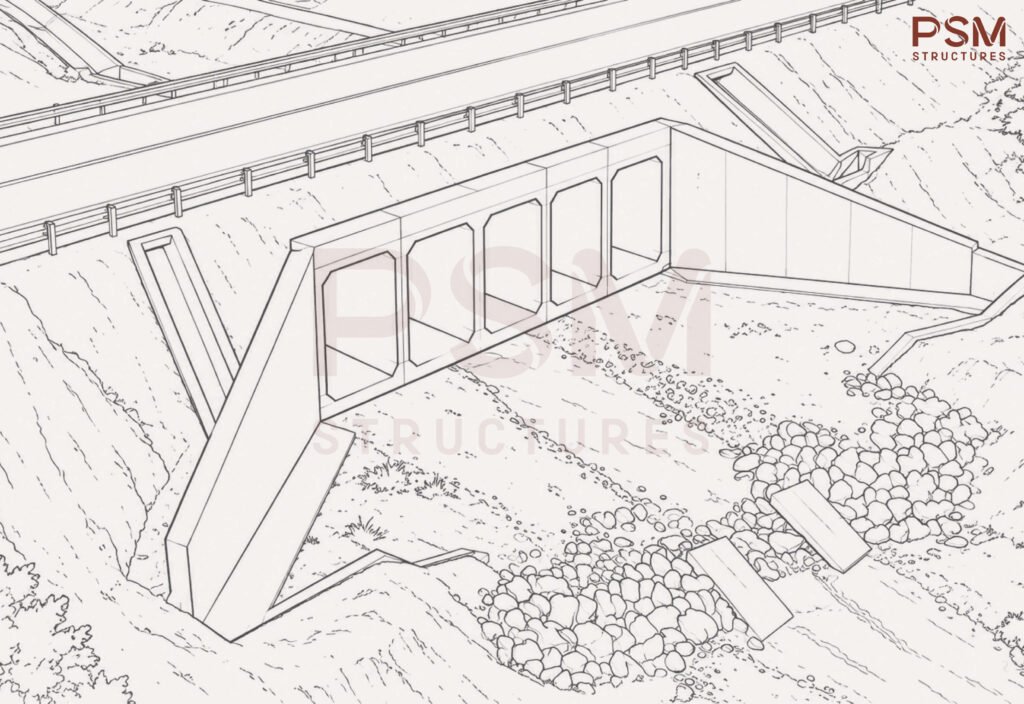
This is particularly relevant for components like precast box culverts used in cable route crossings and drainage works under solar plant roads. Getting the geometry wrong on a culvert during conventional construction means breaking out and repouring. Getting it right in a factory, with accurate detailing from a structural consultancy, means it arrives on site, drops into position, and the backfilling crew gets on with their work.
Single vendor accountability also simplifies the contractual structure of the civil package. Instead of managing a designer, a civil contractor, and a quality inspector as three separate parties, the EPC contractor has one point of contact for structural design intent, shop drawing queries, and erection methodology questions.
Discuss precast civil options for your next solar project with PSM’s structural team.
Solar EPC contractors are switching to precast civil structures because they reduce construction time by 30-50%, eliminate weather-related delays, deliver factory-controlled structural quality, and consolidate civil accountability under a single design-to-erection vendor. For commission-date-driven projects with tight civil windows, precast is structurally sound, IS code compliant, and demonstrably faster to execute on site.
Parv Modh
The Case for Solar EPC Companies to Start Acting on This Now
Three things stand out across these seven reasons. First, schedule compression through parallel fabrication is the single highest-impact benefit for solar EPC projects, and it is realised at no additional design complexity compared to conventional civil. Second, code-compliant, calculation-backed structural design reduces execution risk on a 25-year asset where the cost of civil remediation after commissioning far exceeds the cost of doing it right during construction. Third, consolidated accountability removes the most expensive outcome in civil project management: disputed liability for rework.
PSM Structures has delivered over 20,000 sq.m of precast structural design for industrial and infrastructure projects, with BIM 4D planning tools and execution-ready shop drawings that your site team can use on day one of erection. Explore PSM’s full range of structural engineering services, from precast concrete design and RCC structural engineering to on-site erection support and shop drawing services.
If your next solar project has a civil window that cannot afford the usual delays, contact PSM Structures to discuss your precast consultancy requirements.
Talk to PSM Structures about shop drawings and precast consultancy for your solar project.
FAQs About Precast in Solar EPCs
In a solar plant, precast construction means producing structural civil components, equipment foundations, cable route box culverts, structural support frames, control room elements, and drainage structures in a manufacturing facility under controlled conditions, then transporting and installing them on site. Unlike cast-in-situ construction, where concrete is poured and cured at the project location, precast removes the manufacturing process from the site, reducing weather dependency and quality variability.
The primary mechanism is parallel fabrication. While site preparation, earthworks, and geotechnical works are underway, a precast manufacturer can be casting and curing structural members simultaneously. This removes the sequential dependency that makes conventional civil works a schedule constraint. Industry data from Indian construction projects places the time reduction from this parallel workflow at 30 to 50 percent versus cast-in-situ methods.
Yes, provided the components are designed by a qualified structural consultancy to the relevant IS codes. Precast concrete design in India is governed by IS 1343 (prestressed concrete), IS 456 (plain and reinforced concrete), and IS 13920 (ductile detailing). Structural members designed to IS 1893 for seismic loads are fully achievable in precast. The key is engaging a structural consultancy that does the code analysis as part of the design brief, not as a compliance review after drawings are already complete.
A wide range of solar plant civil components are suitable for precast manufacture: equipment pad foundations, cable route crossings (precast box culverts), structural columns and beams for inverter rooms and control buildings, drainage channel sections, road crossing culverts, retaining wall panels, and cable duct covers. Any component with repeated geometry and defined load conditions is a strong candidate for precast production.
The direct material cost per unit is sometimes higher for precast due to mould fabrication and plant overhead. However, total project cost typically favours precast at scale when labour reduction, waste minimisation, programme compression, reduced rework, and earlier commissioning revenue are included in the comparison. Studies across large-scale Indian construction projects indicate cost reductions of 8 to 15 percent when total project economics are the basis of comparison rather than the materials bill alone.
Yes. Precast components can be engineered to IS 1893 for any seismic zone designation applicable to solar plant sites in India. Properly detailed connections, ductile jointing, and connection reinforcement designed to IS 13920 allow precast structures to perform in seismic Zone II through Zone IV environments. The structural consultancy responsible for the design must conduct explicit seismic analysis for the specific site zone and soil condition — this cannot be assumed from a generic reference drawing.
A precast structural consultant provides: structural analysis and design of precast components for site-specific loading conditions, IS code-compliant drawings stamped by a chartered structural engineer, shop drawings with full dimensional detailing for the manufacturer, coordination with the EPC team on anchor bolt patterns and interface dimensions, and on-site erection support to verify installation methodology and resolve field queries. PSM Structures provides all these services, from initial design through to erection support, under a single consultancy engagement.