Table of Contents
Traditional construction often feels like a race against the elements. You wait for the rain to stop, for the concrete to cure, and for the shuttering to be removed. This uncertainty is exactly why the industry is shifting toward a more controlled, industrial approach. To answer the fundamental question, what is precast concrete, it is a construction product produced by casting concrete in a reusable mold or “form,” which is then cured in a regulated factory environment.
Unlike standard concrete that is poured on-site, precast elements are manufactured off-site and transported to the location for assembly. This shift from a “construction site” to a “manufacturing plant” allows for a level of quality control that is nearly impossible to achieve in the open air. At PSM Structures, we see this technology as the backbone of modern infrastructure, providing the precision needed for complex industrial and institutional projects.
The Core Mechanics of Precast Technology
Precast concrete is concrete that is cast and cured in a controlled factory environment before being transported to a construction site.
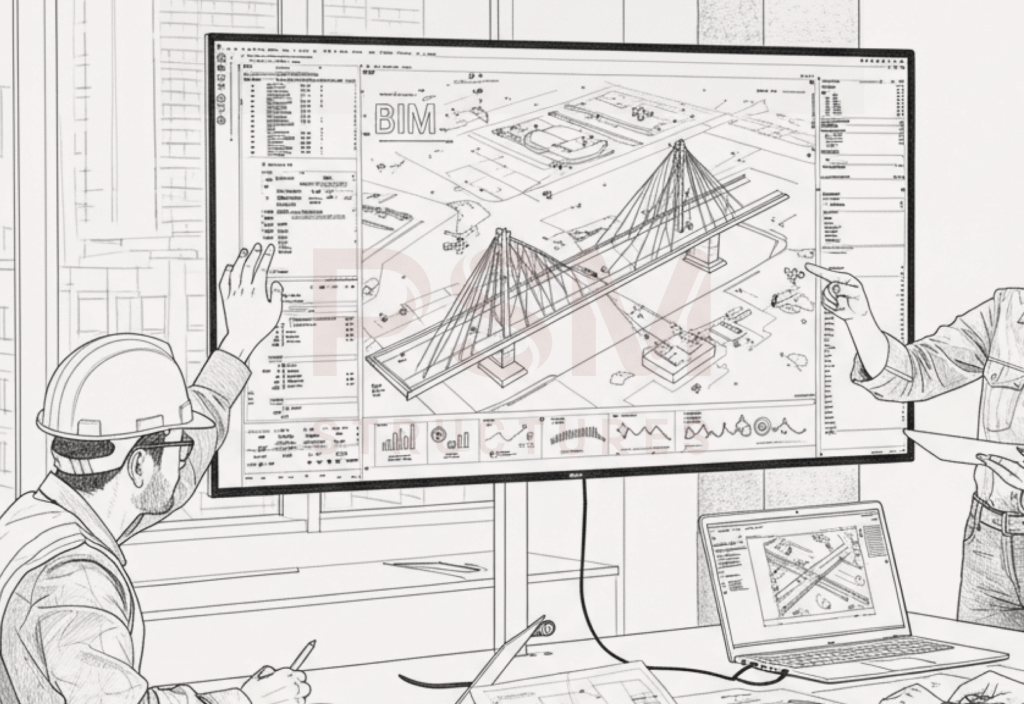
The process of precast concrete construction begins with high-level engineering and shop drawings. Once the design is finalized, the components, ranging from a precast wall to heavy-duty beams, are cast in a plant.
The basic process goes like this: a mould (called a formwork) is prepared, reinforcement steel is placed inside, concrete is poured and vibrated to remove air pockets, and the element is then cured, sometimes using steam, to reach the required strength quickly. Once cured, the element is demoulded, inspected, and sent to the site.
Need a structural partner who understands the nuances of precast design?
Types of Precast Concrete Elements
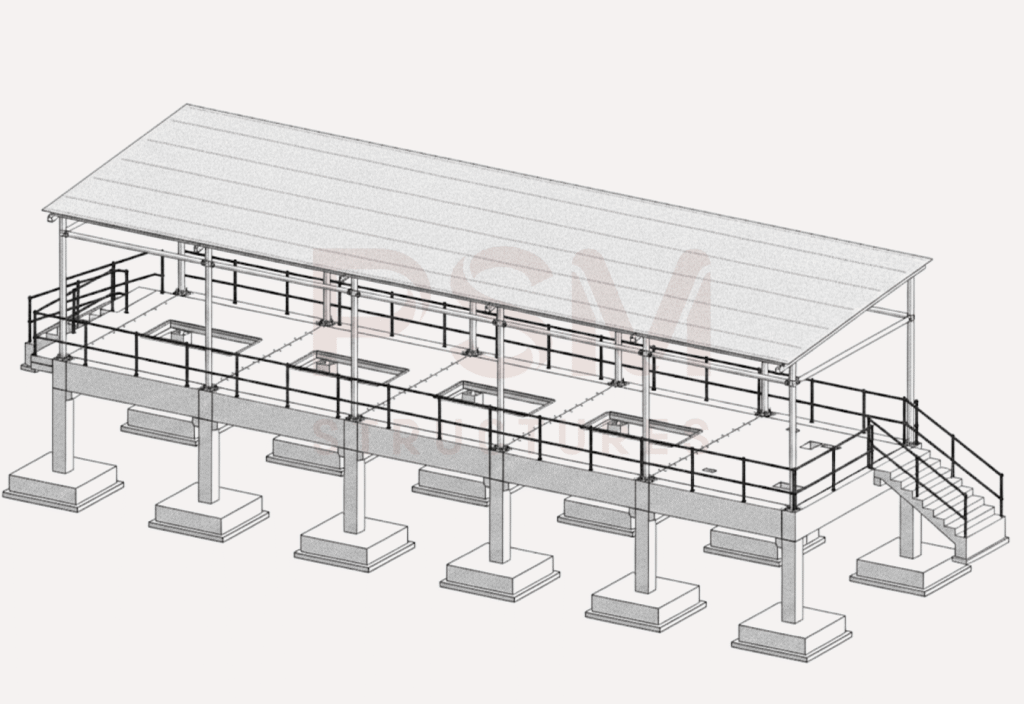
Precast building construction is not a one-size-fits-all solution. It is a modular system where different “Lego-like” pieces come together to form a stable structure.
Precast Concrete Walls and Precast Wall Panels
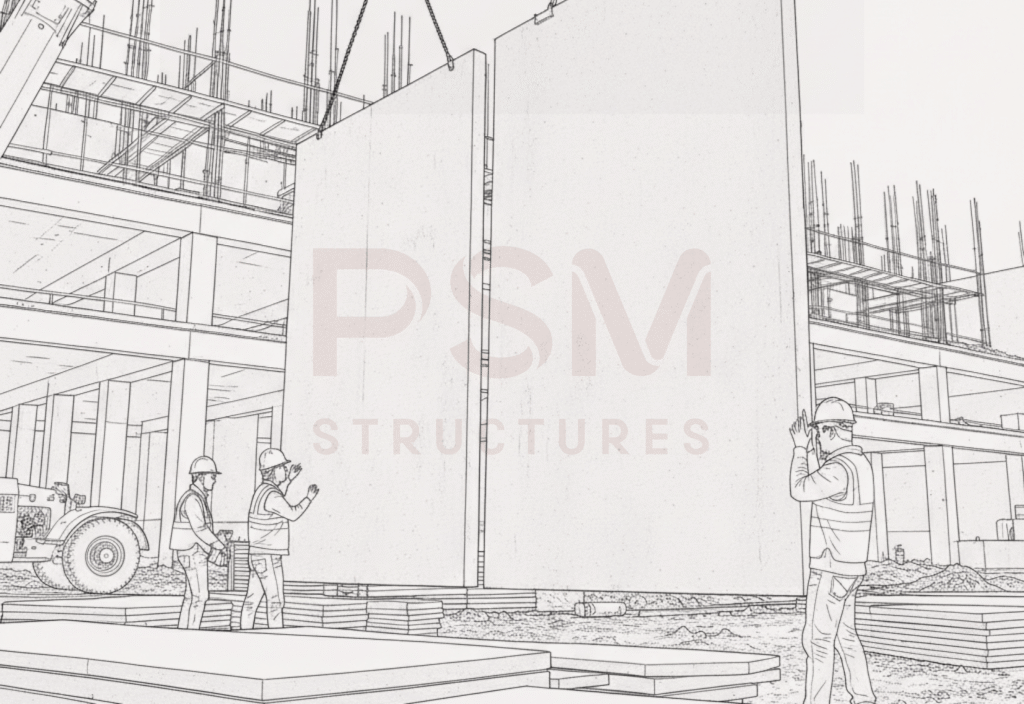
Precast concrete walls, including precast concrete wall panels, are some of the most widely used precast elements in India. They are used for boundary enclosures (precast compound walls), load-bearing walls, cladding systems, and retaining structures. A precast compound wall, for instance, can be installed far faster than a brick wall and offers greater durability and uniformity.
Precast Concrete Slabs
A precast slab is a horizontal structural element manufactured off-site and used as a floor or roof component. Hollow-core slabs are the most popular variety; they are lightweight, span large distances, and reduce the need for intermediate supports. They are common in commercial and industrial buildings.
Precast Beams and Columns
Beams and columns are the skeleton of any precast building frame. When factory-made, they arrive on site with precise dimensions, embedded connections, and pre-drilled anchor points, all of which simplify erection and reduce error on site.
Precast Staircases, Lintels, and Utilities
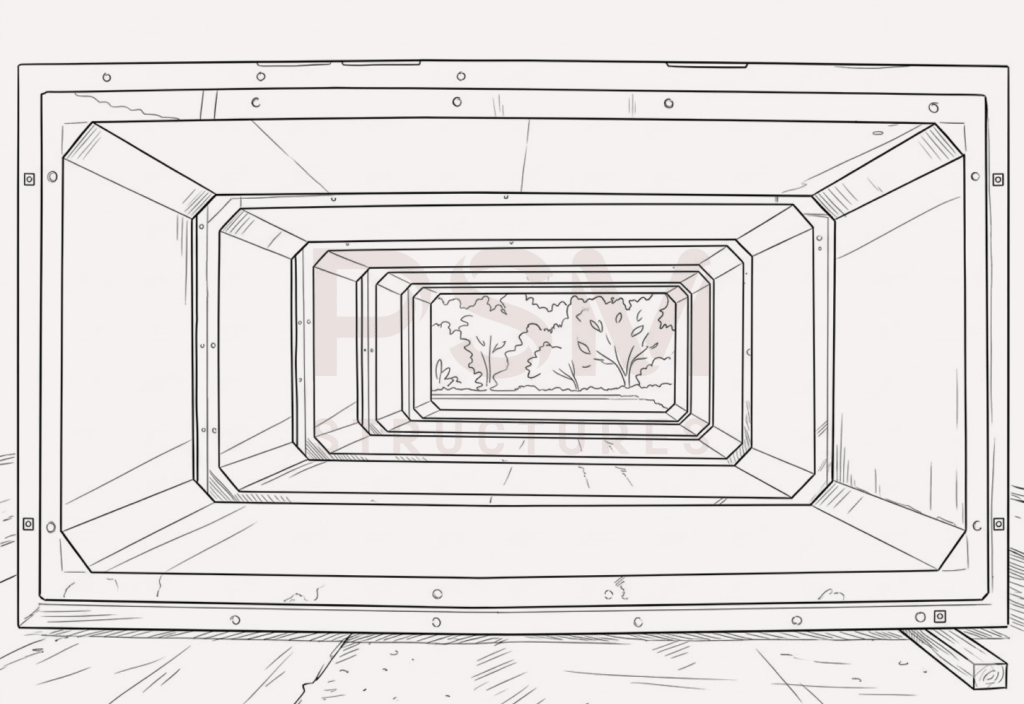
Smaller precast elements like stair flights, lintels, drainage channels, and cable ducts also form part of the precast system, and each one benefits from the same quality control and speed of delivery as the larger components.
If your next project involves precast concrete walls or complex slabs, we are here to help bridge the gap between design and site.
The real power of precast concrete lies in the transition from an unpredictable construction site to a controlled engineering environment. When we design for precast, we are eliminating the human error inherent in on-site pouring. This shift allows us to achieve structural tolerances and high-grade finishes that traditional methods simply cannot match. It’s about moving away from reactive building and moving toward a proactive, manufacturing-based assembly that ensures every beam and precast slab fits exactly as planned.
Parv Modh
Key Benefits of Precast Concrete Construction
The growth of precast in India and globally is not accidental. Developers and contractors have real, measurable reasons to choose it:
Speed
Because elements are manufactured while site preparation is underway, the overall programme compresses significantly. A structure that might take eight months with traditional methods can often be delivered in five.
Quality Control
Factory conditions eliminate the variability that comes with on-site poured concrete. Concrete strength, reinforcement cover, and surface finish are all more consistent.
Reduced Site Disruption
Less concrete mixing, less formwork, fewer workers on site at any given time. For urban projects or those near sensitive environments, this is a meaningful advantage.
Durability
Precast concrete elements, especially when prestressed, perform well under heavy loads and in harsh environments. The Indian precast industry has seen significant uptake in infrastructure projects, bridges, metro stations, and culverts, precisely because of this durability.
Lower Long-Term Costs
Initial costs can be higher than some traditional methods, but reduced labour costs, faster handover, and lower maintenance requirements often deliver better lifecycle value.
Sustainability
Research from the Indian Concrete Institute highlights that precast methods reduce on-site noise and dust pollution significantly.
Looking for execution-ready designs?
Minimise your on-site risks with our expert detailing services.
Precast Concrete in India - A Growing Industry
India’s precast concrete market is expanding rapidly. Government programmes, including Housing for All and Smart Cities Missio,n are driving demand for faster, scalable construction methods. According to India Brand Equity Foundation (IBEF), the Indian construction industry is expected to become the world’s third-largest by 2025, and precast is a significant contributor to that growth.
For EPC firms, developers, and contractors operating in India today, precast is no longer a niche approach. It is becoming standard practice for industrial sheds, boundary walls, residential developments, and infrastructure, and the availability of experienced structural engineering partners to support it is growing alongside that demand.
In markets like Canada, too, precast construction has long been a preferred method for commercial and residential projects, particularly due to its ability to perform in cold climates where cast-in-place concrete is affected by temperature during curing.
The Future is Precast
The shift toward precast concrete is more than just a trend; it is a response to the growing demand for precision and reliability in a fast-moving industry. By moving the heavy lifting from the unpredictable environment of a job site into a controlled facility, projects achieve a level of durability and finish that traditional methods rarely match. Whether it is the rapid assembly of precast concrete slabs or the thermal performance of high-grade precast concrete walls, this technology provides a stable foundation for the future of our cities.
The transition from site-poured concrete to factory-manufactured components requires a change in mindset. It moves construction toward an assembly-based model where the success of the build is decided long before the first crane arrives. When the engineering is handled with technical precision and a deep understanding of on-site realities, the entire process becomes a predictable, logical sequence of events.
At PSM Structures, we focus on providing that necessary bridge between complex design and practical execution. By ensuring every connection and detail is mapped out correctly, we help projects move forward with fewer surprises and greater confidence. As the construction landscape in India and Canada continues to evolve, embracing these advanced systems is the most direct path to building safer, faster, and more resilient structures.
Explore precast design and other structural design services at PSM Structures.
FAQs About Precast Concrete
It is a method where building components are manufactured in a factory and then transported to the construction site for installation. This replaces the traditional method of pouring concrete into forms on the actual building site.
A precast slab is a ready-made floor or roof element. Common types include solid slabs or hollow-core slabs, which are lighter and allow for longer spans between supports.
It refers to the specialized machinery, software, and engineering methods used to design, cast, and assemble concrete elements in a modular fashion.
Precast concrete walls are known for extreme durability. Because they are made with high-density concrete in controlled conditions, they often have a lifespan exceeding 50 to 100 years with minimal maintenance.
While the initial material cost might be higher, the overall project cost is often lower due to massive savings in labor, time, and the reduction of on-site waste.
Precast concrete is produced under controlled factory conditions, which generally results in higher and more consistent strength compared to site-mixed concrete. Prestressed precast elements are specifically engineered to carry heavy loads over long spans with minimal deflection.