Table of Contents
You’ve approved the structural design. The architectural drawings look perfect. Your precast manufacturer is ready to start production. Then someone asks: “Where are the shop drawings?”
If that question makes you pause, you’re not alone. Many project stakeholders don’t realize that structural drawings and shop drawings serve completely different purposes. One shows what needs to be built. The other shows exactly how to build it.
Shop drawing creation is where engineering theory meets manufacturing reality. In precast construction, these documents determine whether your double-tee beams fit perfectly or require costly field modifications. They decide if your wall panels arrive with anchor locations that actually align with your steel framework. They’re the difference between a project that flows and one that stalls.
Let’s break down why shop drawings matter more than most people realise, what goes into creating them, and how they protect your project from expensive mistakes.
What Shop Drawing Means in Construction
A shop drawing is a detailed, dimension-specific document created by fabricators, manufacturers, or specialized detailing firms. Unlike design drawings that show overall intent and performance requirements, shop drawings provide explicit instructions for manufacturing and installation.
Think of it this way: an architect’s drawing might show a precast wall panel with “typical connections as per structural notes.” The shop drawing services team takes that general instruction and produces a document showing every embed location down to the millimeter, every reinforcement bar with its exact bend schedule, and every connection detail with bolt sizes, weld lengths, and tolerances.
The shop drawing meaning goes beyond just documentation. It’s a communication tool that forces different disciplines to reconcile their requirements before fabrication begins. The structural engineer verifies load paths. The architect confirms visual alignment. The MEP consultant checks for clashes. The contractor reviews constructability.
According to construction industry data, projects using detailed shop drawings report 30-40% fewer site issues compared to those working directly from design drawings. That’s not surprising when you consider how many coordination gaps exist between different design disciplines.
Shop Drawing vs Working Drawing vs Fabrication Drawing
Confusion exists because different terms get used interchangeably. Here’s the actual distinction:
Working Drawings
These are the complete set of contract documents, including architectural, structural, MEP, and site plans. These form your construction contract. They show what the finished building should look like and how it should perform, but they don’t provide manufacturing instructions.
Shop Drawings
These are derived from working drawings but add a critical layer of detail. They show how individual components will be fabricated and where they’ll be installed. For precast work, this includes panel dimensions, reinforcement layouts, embed locations, lifting points, and connection details.
Fabrication Drawings
Fabrication drawings are often synonymous with shop drawings in precast work, though some firms distinguish them slightly. A fabrication drawing focuses purely on the manufacturing process, while a shop drawing includes both manufacturing and installation information.
As-built Drawings
As-built drawings come later in the process. These documents show what actually got installed, including any field changes or modifications. They’re critical for facility management but serve a different purpose than shop drawings.
In precast construction specifically, the shop drawing is your manufacturing blueprint. PSM Structures produces these documents with precise attention to reinforcement placement, connection hardware, and dimensional accuracy because precast elements can’t be easily modified once cast.
At PSM Structures, we believe that a project is built twice: once on the computer, and once on the ground. The first one makes the second one possible.
Parv Modh
Why Precast Projects Depend on Detailed Shop Drawings
Precast concrete construction operates under different rules than cast-in-place work. Once a panel or beam is manufactured, its dimensions and embed locations are fixed. You can’t shift a plate anchor by 50mm on site the way you might adjust formwork for a conventional pour.
This inflexibility makes upfront accuracy absolutely critical. Shop drawings serve several vital functions:
1. Zero Tolerance for Error
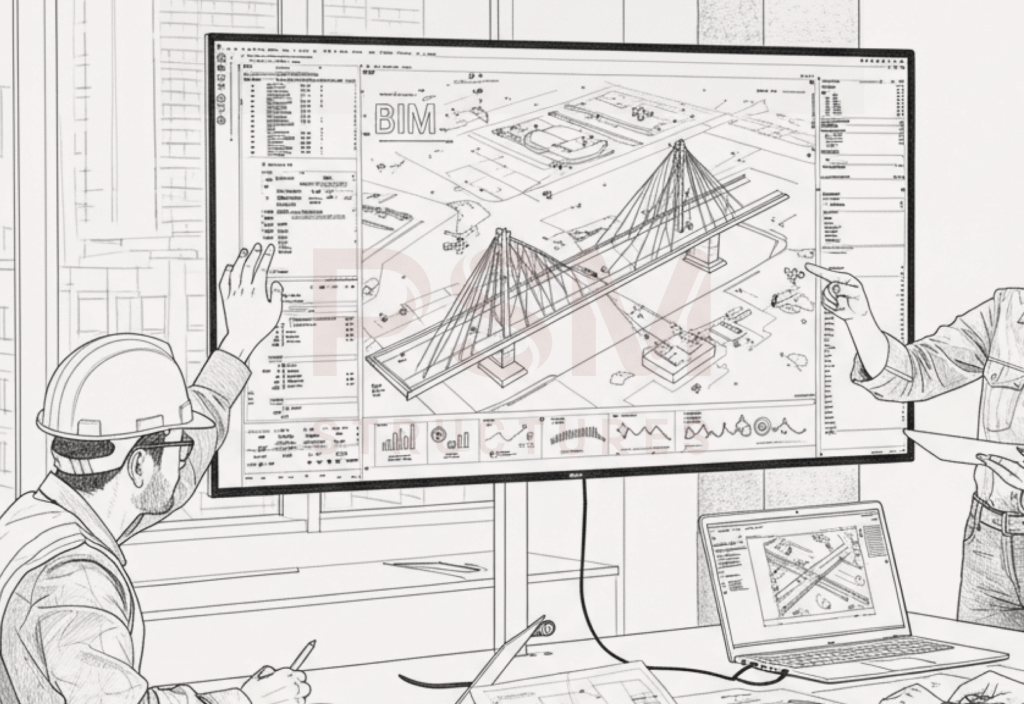
Precast elements are manufactured off-site. They must fit together like a giant, heavy Lego set. If the shop drawing services provider misses a tolerance issue, the elements simply won’t connect. We use tools like BIM 4D planning and TEKLA to model these connections in a virtual environment first, ensuring they fit before any physical work begins.
2. Manufacturing Precision
Precast plants work from shop drawings, not architectural plans. The shop drawing tells the form setter exactly where to place each piece of reinforcement, every embed, every blockout. It specifies concrete cover requirements, pour sequences, and curing procedures. Without this level of detail, you’re relying on interpretation, which introduces variability.
3. Installation Sequencing
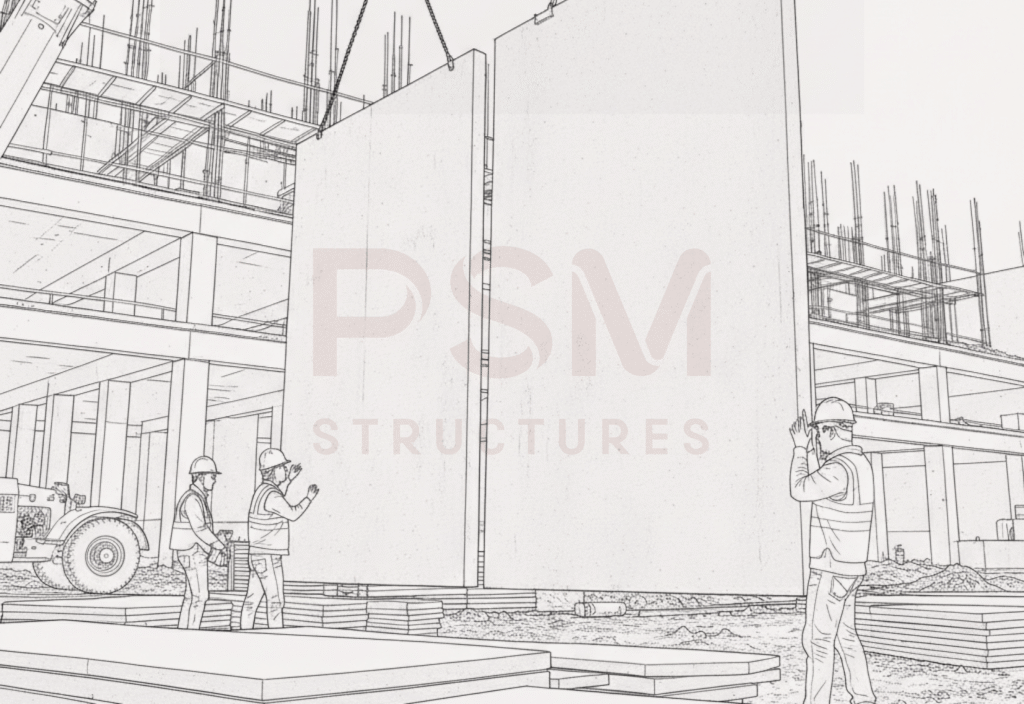
Precast erection is like assembling a three-dimensional puzzle. Shop drawings show not just what goes where, but in what order. They identify which panels get installed first, where temporary bracing attaches, and how adjacent elements connect. This sequencing planning reduces crane time and prevents situations where you’ve installed something that blocks access for the next piece.
4. Quality Control Documentation
Shop drawings become your quality benchmark. Inspectors verify that fabricated elements match the approved shop drawings. Any deviation requires documentation and often re-approval. This traceability ensures accountability throughout the manufacturing and installation process.
5. Material Optimization
A well-detailed drawing doesn’t just show you how to build; it shows you how to build economically. By detailing the exact reinforcement and concrete volume, we reduce wastage. Research by the Precast/Prestressed Concrete Institute (PCI) indicates that accurate detailing can reduce material waste by up to 15%.
Ready to eliminate coordination issues before they reach your site? PSM Structures delivers buildable, code-compliant shop drawings for precast projects across India and Canada.
What Goes Into a Complete Precast Shop Drawing
Creating useful shop drawings requires understanding both engineering principles and construction realities. At PSM Structures, our shop drawing process includes multiple layers of information:
Dimensional Information
Every element gets precisely dimensioned. For a precast wall panel, this means overall height and width, but also the location of every opening, every chamfer, every reveal. Dimensions reference from consistent datums so there’s no ambiguity about measurement points.
Reinforcement Details
Bar sizes, spacing, lap lengths, bend angles, cover requirements—all specified graphically and in schedules. The shop drawing shows how reinforcement cages get assembled, where splices occur, and how bars interact with embeds. For post-tensioned elements, it details tendon paths, anchorage zones, and stressing sequences.
Connection Hardware
Every embed plate, anchor bolt, sleeve, and insert gets located with three-dimensional coordinates. The drawing specifies hardware grades, coating requirements, and installation tolerances. Connection details show both the precast side and the receiving side, ensuring compatibility.
Erection Information
Lifting point locations with capacities, piece weights, center of gravity marks, temporary bracing attachment points, and erection sequence numbers all appear on shop drawings. This information is critical for safe handling.
Material Specifications
Concrete mix design requirements, reinforcement grades, embed material specifications, and any special testing requirements get documented. This ensures the manufacturing process uses approved materials.
The Shop Drawing Review and Approval Process
Creating the drawing is only half the work. The review process is where coordination actually happens.
Typically, the precast detailer or manufacturer produces the first submission. This goes to the structural engineer of record for technical review. The engineer verifies that the detailing complies with their design intent, that connections can carry the required loads, and that the element will perform as intended structurally.
Simultaneously or sequentially, the drawings go to the architect for aesthetic review and to other trades for coordination review. The general contractor checks constructability and sequencing.
Comments come back. Revisions happen. This iterative process continues until all parties approve. In complex projects, some shop drawings might go through four or five review cycles before approval.
The time investment here pays dividends. Research from construction management studies indicates that each hour spent in shop drawing coordination saves approximately 5-10 hours of field problem-solving time.
PSM Structures has developed streamlined review protocols that reduce approval cycles without sacrificing accuracy. Our experience with over 20,000 sq.m of precast design means we anticipate coordination issues before they appear in submissions.
Confused about who handles shop drawings for your precast project?
Let’s talk through your specific requirements and timeline.
Conclusion
The success of a precast project is determined long before the first truck arrives at the site. It is determined in the detailing room. A shop drawing is more than lines on a page; it is a commitment to precision, safety, and budget control.
In an industry that often struggles with delays and overruns, accurate detailing is your best insurance policy. It ensures that what you design is exactly what gets built.
At PSM Structures, we view shop drawings as more than deliverables; they’re risk management tools. Every embed location we verify, every connection detail we coordinate, and every tolerance we plan for represents a potential site problem we’ve prevented.
Our goal isn’t just to produce compliant documents. It’s to give you structural clarity, reduce execution risk, and help your project finish faster, safer, and smarter.
Ready to experience the difference that buildable shop drawings make? Contact PSM Structures today to discuss your precast project requirements. Whether you’re planning an industrial facility in Ahmedabad or an infrastructure project in Canada, we bring the expertise to ensure your design intent becomes site reality.
FAQs About Precast Shop Drawing
Typically, the shop drawings are prepared by the precast manufacturer or a specialized structural engineering consultancy like PSM Structures. We work on behalf of contractors or developers to ensure the drawings meet all structural codes and site requirements.
The timeline varies based on project complexity. For a standard industrial structure, the initial set might take 2–3 weeks. However, using experienced shop drawing services can speed up the approval process by reducing revisions.
Absolutely. We provide detailing and structural services for clients in Canada and other international markets, adhering to their local codes and standards.
We utilize a suite of industry-standard tools including AutoCAD for 2D detailing and BIM-capable software for 3D modeling and clash detection, ensuring high accuracy.
Yes, but modifications require re-submission and re-approval. If changes affect structural performance, the engineer of record must review them. Frequent post-approval changes indicate inadequate initial coordination.