Table of Contents
When infrastructure projects face tight deadlines and complex water management requirements, the choice of structural components determines the project’s success. Traditional cast-in-situ methods often struggle with weather delays and quality control issues. This is where the precast concrete box culvert serves as a superior alternative. Essentially, a box culvert is a rectangular reinforced concrete structure used to convey water, create underground tunnels, or provide passage for utilities.
What Is a Precast Box Culvert?
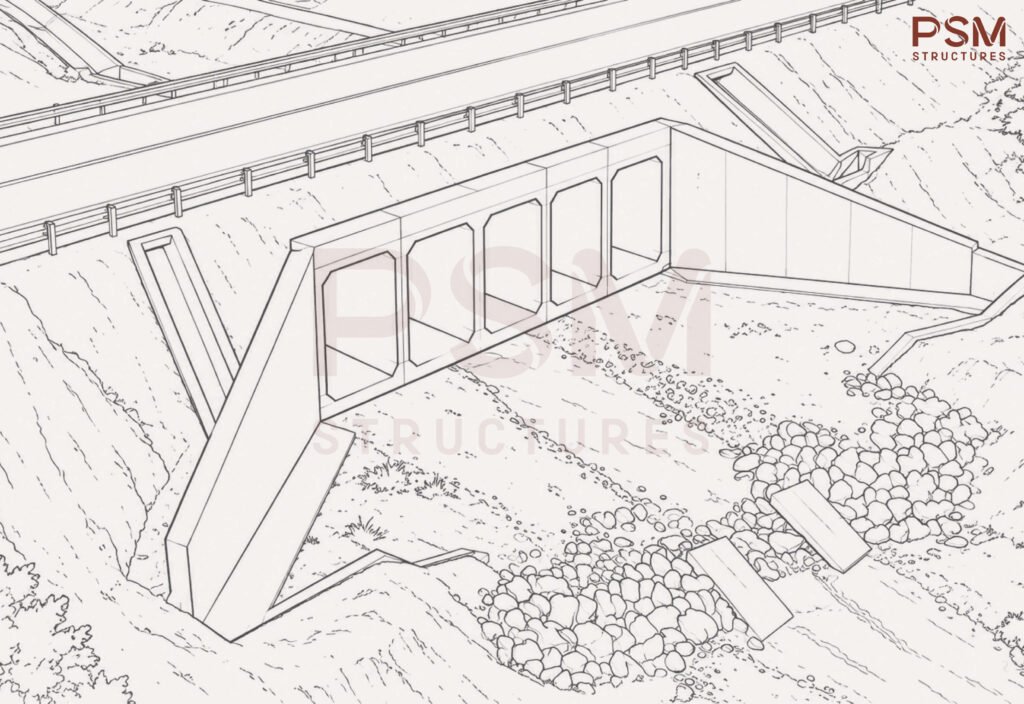
A box culvert is a rectangular or square-section conduit that passes water, traffic, or utilities under an embankment, road, or railway. Unlike circular pipe culverts, a box culvert has four flat sides: a base slab, two vertical walls, and a top slab. This four-sided shape gives it a much larger hydraulic cross-section for the same installation depth, making it the preferred choice wherever high flow volumes, shallow cover, or heavy load-bearing capacity are required.
Box culverts are typically used for:
- Stormwater and floodwater drainage under roads and highways
- Irrigation canals passing beneath embankments
- Pedestrian and utility underpasses
- Railway drainage crossings and level crossings
- Industrial access roads over drainage channels
According to the Indian Roads Congress (IRC:SP:13), culverts account for a significant share of drainage structures on national highways, and the shift toward precast options has been growing steadily across NHAI and state highway projects over the past decade.
Ensure your project is buildable and code-compliant with our specialized design services.
Key Structural Components of a Precast Box Culvert
Understanding what a precast box culvert is made of helps navigate its performance under load and strength over time.
Base Slab
The base slab is the bottom horizontal element that sits on the prepared foundation. It distributes the load from the water inside, the soil above, and the traffic passing overhead into the ground below. The base slab thickness is determined by the span of the culvert and the bearing capacity of the soil it rests on. In poor ground conditions, a blinding layer or lean concrete bed is placed first to ensure uniform bearing.
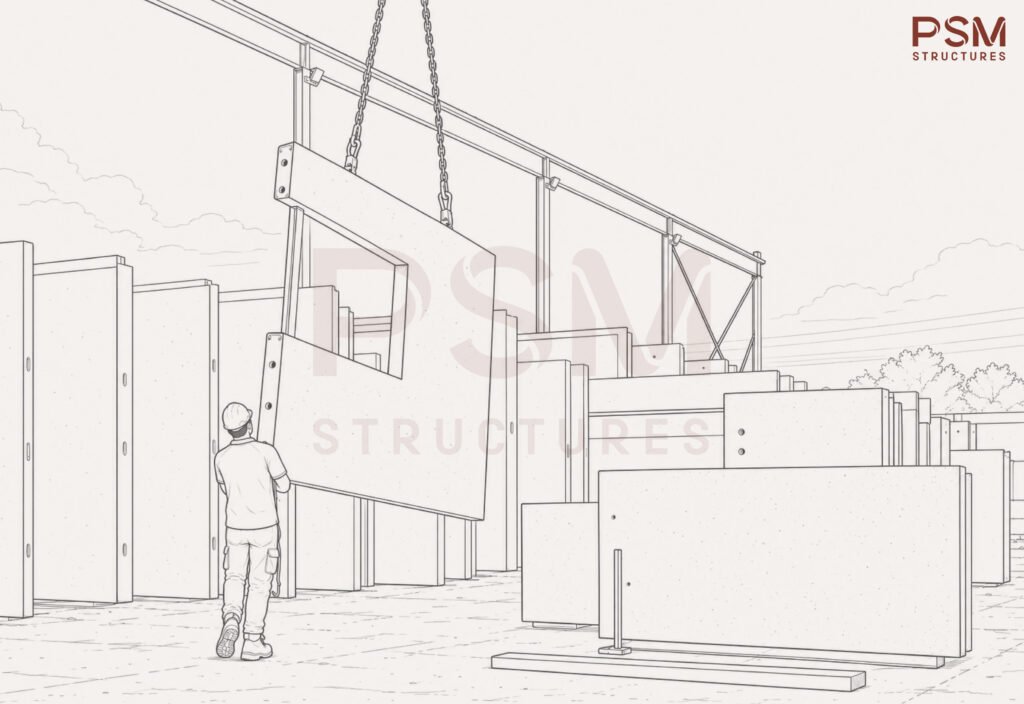
Precast concrete walls, including precast concrete wall panels, are some of the most widely used precast elements in India. They are used for boundary enclosures (precast compound walls), load-bearing walls, cladding systems, and retaining structures. A precast compound wall, for instance, can be installed far faster than a brick wall and offers greater durability and uniformity.
Side Walls
The two vertical walls carry the lateral earth pressure from the surrounding backfill and transfer vertical loads from the top slab down to the base. Wall thickness is directly related to the height of the culvert, the depth of soil cover, and any surcharge from traffic or rail loading above. In most standard designs, walls range from 150mm to 400mm thick, depending on the loading class.
Top Slab
The top slab spans horizontally between the two walls and carries the full dead load of soil cover plus live load from vehicles, equipment, or rail traffic above. It is the most heavily loaded element in most culvert designs and is reinforced accordingly at both the top and bottom faces to resist bending. For deep burial or heavy loading, haunch reinforcement at the wall-slab junction is added to reduce stress concentrations at the corners.
Reinforcement
Precast box culverts use high-yield deformed steel bars (Fe 500 or Fe 500D as per IS 1786) arranged as a cage inside each element. The reinforcement is designed to resist bending, shear, and in some cases, thrust loads from high-overburden conditions. Cover to reinforcement, typically 40mm to 50mm in aggressive soil or water contact zones, is one of the most critical quality parameters in factory production.
Joints
Each section of a precast box culvert connects to the next at a joint. Joints are the most vulnerable part of any culvert installation and must be detailed to prevent infiltration of groundwater or exfiltration of the contents. The three most common joint types used in Indian and Canadian practice are:
Rubber ring (push-fit) joints
A preformed elastomeric ring compressed between a spigot and socket end. Suitable for most drainage applications and capable of accommodating minor angular deflection and differential settlement.
Mastic or butyl tape joints
A preformed compressible sealant applied between flat-ended sections before they are bolted or strapped together. Common for large-span units where socket formation is impractical.
Mortar joints
Used in lower-risk installations where watertightness is less critical. Lower cost but less reliable in areas with differential settlement.
Optimize Your Structural Design. Get code-compliant detailing that minimizes onsite errors.
The structures that hold up civilization are the ones nobody ever sees. A precast box culvert buried under a highway will outlast the road above it, the contractor who built it, and the engineer who designed it. Get the details right, and it works forever. Cut corners, and the ground will find them
Parv Modh
Top 3 Features of a Precast Concrete Box Culvert
Understanding the anatomy of a box culvert helps in selecting the right unit for specific environmental challenges. These structures are defined by several high-performance characteristics:
1. Monolithic Structural Integrity
Most precast units are cast as a single, solid piece. This monolithic action allows the bottom slab to act as a raft foundation, distributing the load across the entire footprint of the structure. This feature eliminates the need for separate, costly footings in many soil conditions.
2. Specialized Jointing Systems
The connection between sections is the most critical point of any culvert run. Modern precast units utilize tongue and groove or single offset joints. According to industry standards such as ASTM C1433, these joints must be formed with such precision that they create a continuous, stable line.
Factory conditions eliminate the variability that comes with on-site poured concrete. Concrete strength, reinforcement cover, and surface finish are all more consistent.
3. Hydraulic Efficiency
Unlike circular pipes, the flat-bottomed geometry of a box culvert offers a larger flow area for the same height. This is particularly useful in “low cover” areas where a road is close to the water level. The smooth factory finish of the internal concrete (the “invert”) also lowers the Manning’s roughness coefficient, allowing water to move faster with less sediment buildup.
Looking for execution-ready designs?
Minimise your on-site risks with our expert detailing services.
Types of Precast Box Culverts
Not all precast box culverts are the same shape or configuration. The design is adapted to site conditions and the project requirements.
Single Cell Box Culvert
The standard configuration: one rectangular passage. This covers the majority of highway, industrial, and urban drainage applications.
Multi-Cell (Twin or Triple) Box Culvert
Two or three box sections are placed side by side under a single road or embankment. Used where flow volumes exceed what a single cell can handle or where a wide crossing is needed. Multi-cell units can either be cast as individual sections placed adjacent to each other, or as a single wide precast unit.
Skewed Box Culvert
Where the road or embankment does not cross a waterway at 90 degrees, a skewed culvert is required. The end sections are cut or formed at an angle to match the skew. This requires careful detailing in the shop drawings to ensure the load paths remain correct at the angled ends.
Arch and Inverted-U Sections
For very wide spans where a flat top slab becomes uneconomical, an arched top profile can be used. These are less common in standard infrastructure but appear in pedestrian underpasses and irrigation crossings.
Not Sure Which Culvert Configuration Is Right for Your Project?
PSM Structures engineers can review your site conditions and recommend the correct span, depth, loading class, and joint system.
Where Precast Box Culverts Are Used
Road and Highway Drainage
The largest use of precast box culverts is under highways, where they carry natural watercourses under the road pavement. NHAI specifies precast units for most new projects due to programme constraints and quality requirements.
Railway Crossings and Underpasses
Box culverts under rail embankments must carry heavy static and dynamic loads from locomotive and freight traffic. The closed box section provides the stiffness required to resist rail loading without excessive deflection. Most countries have detailed specifications for culvert design under their respective infrastructure.
Storm Sewer Systems
Urban municipalities use precast box culverts to construct underground stormwater networks capable of handling flash flood flows. The large cross-section and smooth internal surface allow rapid discharge to prevent road flooding.
Pedestrian and Utility Tunnels
Where a footpath, cycle lane, or service corridor must pass under an embankment or road, a precast box culvert provides a structurally complete tunnel without the cost of full tunnel construction. Heights of 1.8m to 2.4m are common for pedestrian underpasses.
Short-Span Bridges
For spans up to approximately 6m, a precast box culvert with adequate wall thickness and top slab reinforcement can function as a buried bridge structure, carrying both the waterway below and full highway traffic above. This is considerably more economical than constructing a conventional bridge for short crossings.
Building for Longevity
A precast concrete box culvert is one of the most technically complete structural products in civil infrastructure. Every dimension, concrete grade, reinforcement arrangement, and joint detail serves a specific engineering purpose tied to the loads it carries, the soil it sits in, the water it passes, and the traffic that runs above it.
The reason precast is preferred over cast-in-situ is not simply about speed, though faster installation is a real benefit. It is about the fact that structural quality is far easier to control and verify in a factory environment than at the bottom of a trench on a live construction site. When the concrete grade, reinforcement cover, dimensional accuracy, and joint performance all need to be relied upon for 50 or more years of service life, the process that produces the unit matters as much as the specification that describes it.
Getting that design right, from hydraulic sizing through to the last bar mark on the shop drawing, is what PSM Structures does every day for EPC firms, contractors, and precast manufacturers across India and Canada.
Ready to Start Your Precast Box Culvert Project?
FAQs About Precast Concrete Box Culverts
A box culvert is a rectangular reinforced concrete structure used to channel water through an opening, typically under a roadway or railway. It consists of a top slab, bottom slab, and two side walls.
Manufacturers have specialized precast concrete plants that use heavy-duty steel molds and high-strength concrete mixes. They produce units based on engineering designs provided by consultants like PSM Structures.
They are made by placing a steel reinforcement cage into a mold, pouring concrete, and then using vibration and steam-curing to ensure a dense, high-strength finish before the mold is stripped.
Leading manufacturers are typically large-scale infrastructure suppliers. In India and Canada, these firms are certified by national standards bodies to ensure the concrete meets specific durability and strength grades.
A box culvert can handle larger volumes of water at a lower height compared to a pipe, making it ideal for areas with limited vertical space or where a flat bottom is needed for the streambed.
Yes. PSM Structures provides complete structural design, reinforcement detailing, and manufacturer-ready shop drawings for precast box culverts. Our drawings follow IS, IRC, and client-specific standards and are reviewed for on-site buildability before issue, so your precast yard can begin production without engineering queries.