Table of Contents
The construction landscape in India is currently facing a massive squeeze. Developers in cities like Ahmedabad, Pune, and Chandigarh are dealing with rising labour costs, unpredictable weather patterns, and the constant pressure to deliver units faster than ever before. For a long time, the solution was simply to throw more resources at a site. But here’s the thing: you can’t solve a logic problem with more manual labour.
What this really means is that the traditional “design-bid-build” cycle is being replaced by a “design-manufacture-assemble” mindset. At the heart of this change is precast construction. By moving the core of the building process into a controlled factory environment, we aren’t just changing where the concrete is poured; we are changing how every single phase of a project is conceptualised. If you are looking to build a project in 2026, understanding precast design services is no longer optional; it is the foundation of a successful delivery.
Why Precast Construction Is Gaining Ground in India
The Indian construction sector is under pressure to modernise. With the government pushing for faster infrastructure development and industrial growth, the traditional approach of casting everything on-site is becoming a bottleneck. Precast offers a solution that aligns with the pace India needs right now.
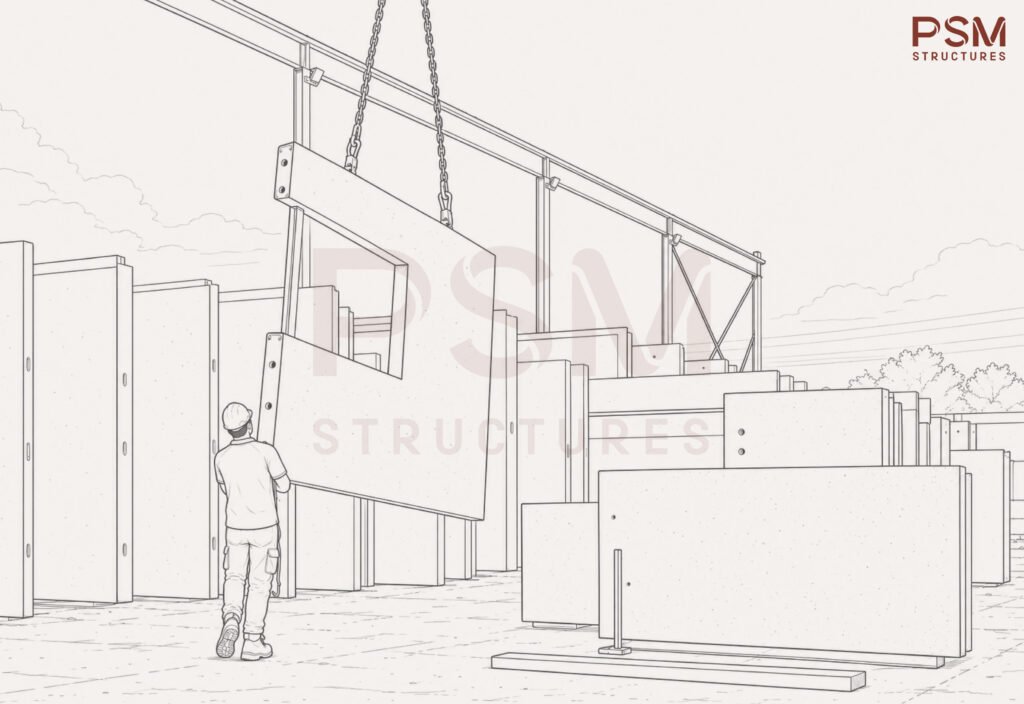
What this really means is that precast components like precast retaining walls, precast box culverts, and full precast buildings are being manufactured in controlled environments while site preparation happens in parallel. This dual-track approach cuts project timelines dramatically. A study published in the Journal of Construction Engineering and Management found that precast construction reduces overall project duration by 30-40% on average.
But speed isn’t the only advantage. Quality control becomes far more predictable when you’re working in a factory setting rather than dealing with weather, site access issues, and variable labour skills. Every precast element is manufactured to exact specifications, tested, and ready for installation. For developers and contractors, this means fewer surprises during execution and better adherence to design intent.
Cities like Ahmedabad, Pune, and Chandigarh are seeing increased adoption of precast solutions for warehouses, industrial facilities, residential complexes, and infrastructure projects. The reason is simple: precast works.
The Logic of Precast Design Services
When we talk about precast construction, many people immediately think of massive concrete slabs. However, the real magic happens months before a single truck arrives at the site. Modern precast design services involve a high level of front-end engineering. Unlike traditional RCC, where many decisions are made on the fly by site supervisors, precast requires every conduit, sleeve, and connection to be mapped out in a digital twin.
Here’s how it works in practice. Precast design services start by understanding not just what needs to be built, but how it will be manufactured, transported, and erected on site. This means thinking about crane access, connection details, and sequencing long before the first element is cast. At PSM Structures, we’ve designed over 50,000 sq m of precast projects, and the difference between a smooth installation and a site nightmare usually comes down to decisions made during the design phase.
Now comes the important part: coordination. Precast projects require tight coordination between structural engineers, precast manufacturers, and erection teams. Tools like STAAD Pro, ETABS, SAFE, and BIM 4D planning software allow teams to visualise the entire construction sequence before a single truck leaves the plant. This level of pre-planning reduces rework, minimises safety risks, and keeps projects on schedule.
For EPC firms and contractors, this shift means getting involved earlier in the design process. The traditional “design-bid-build” sequence doesn’t work as well with precast. Instead, successful projects adopt a more integrated approach where buildability is considered from the very beginning. According to Construction Week Online, this collaborative planning approach can reduce change orders by up to 60%.
The construction industry doesn't reward perfection. It rewards predictability. Precast gives you both, but predictability is what actually gets projects finished.
Parv Modh
Infrastructure and Housing: The Versatility of Precast Structures
A common misconception is that precast is only for massive industrial warehouses. While it’s true that precast structures dominate the industrial sector, 2026 is seeing a massive surge in precast houses and urban infrastructure.
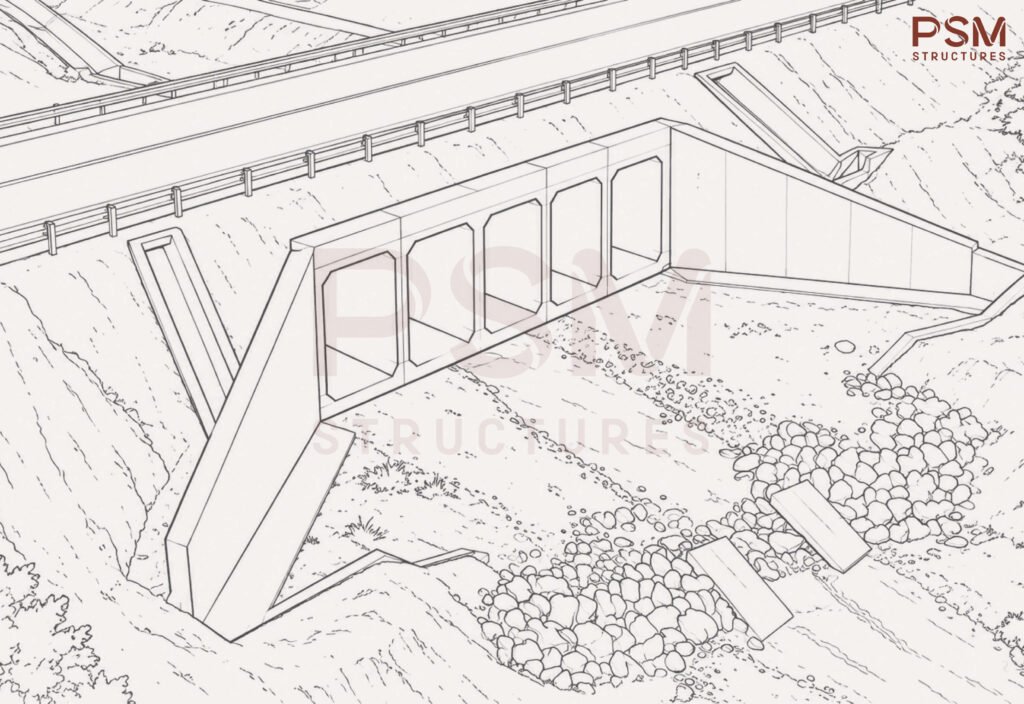
Precast Retaining Walls and Box Culverts
In rapidly developing regions like Pune and Ahmedabad, infrastructure needs to keep pace with population growth. Using a precast box culvert for drainage or road crossings allows a contractor to finish in days what used to take months. Similarly, a precast retaining wall offers immediate soil stabilization, allowing other site works to proceed without waiting for concrete to cure.
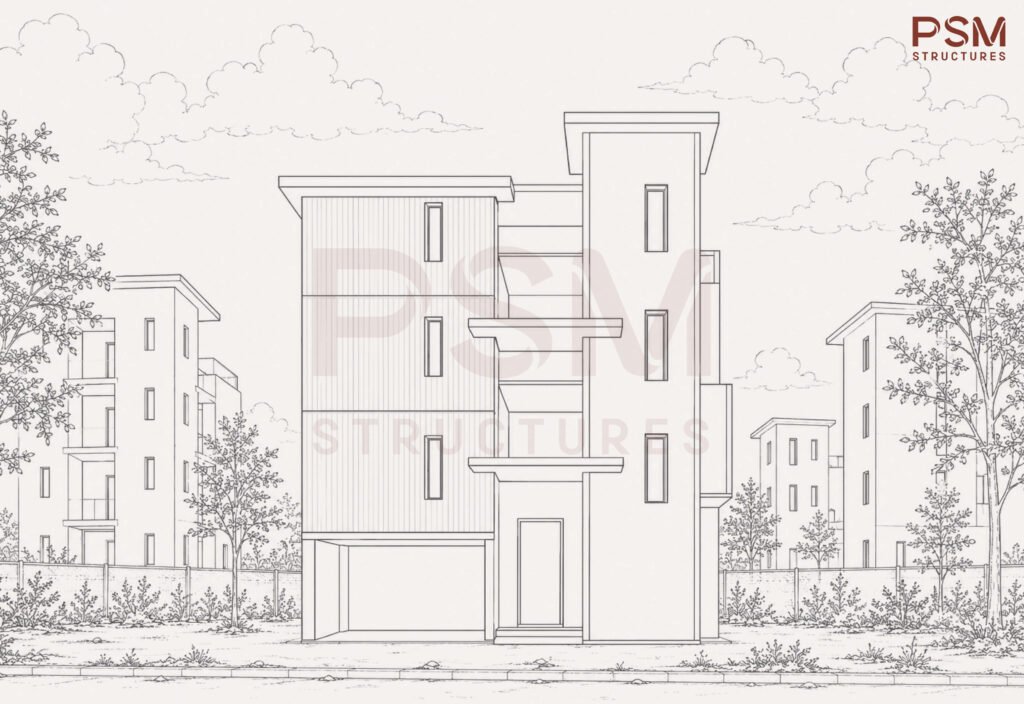
The Rise of Precast Houses
For residential developers, the appeal of precast houses lies in the consistency of the finish. When you build with traditional brick and mortar, the quality of your walls depends entirely on the skill of the mason on that particular day. In a precast environment, the surface finish is factory-perfect every time. This reduces the need for thick plastering and allows for faster painting and interior fit-outs.
According to a report by the Ministry of Housing and Urban Affairs (MoHUA), the adoption of modern construction technologies like precast is essential for meeting India’s massive housing demand under various government schemes.
The key is working with a structural engineering consultancy that understands both the design side and the practical realities of precast manufacture and erection. At PSM Structures, our experience includes working with precast manufacturers, EPC firms, and contractors to ensure that designs are not just code-compliant but genuinely buildable.
The Real Advantages: Speed, Precision, and Risk Reduction
What do you actually gain by switching to precast?
Speed
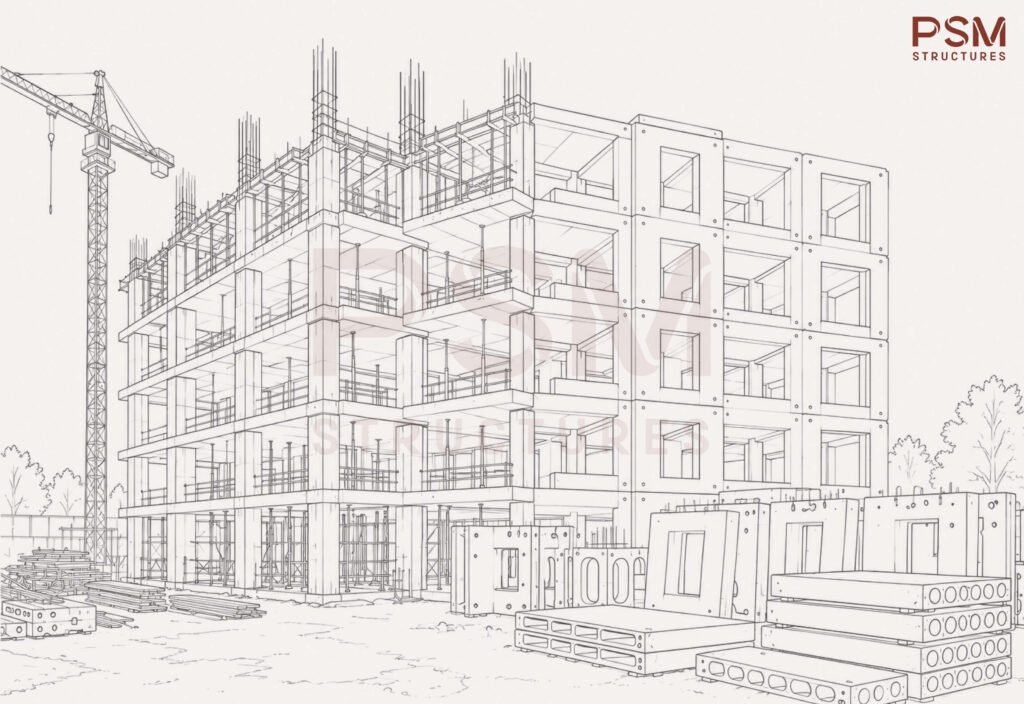
A typical precast building can be erected in a fraction of the time required for conventional construction. While foundations are being prepared, precast elements are being manufactured. Once the site is ready, installation moves quickly. We’ve seen industrial buildings go from foundation to roof in under two months using precast, a timeline that would be nearly impossible with traditional methods.
Precision
Precast components are manufactured to tolerances of just a few millimetres. This level of accuracy is difficult to achieve on-site, especially for large-scale projects. Better precision means better fit during installation, fewer alignment issues, and cleaner final results.
Risk Reduction
Construction sites are inherently risky places. By moving the majority of concrete work to a controlled factory environment, you reduce site labor requirements and the associated safety risks. Weather delays become less critical since the bulk of the work isn’t happening outdoors. Material waste drops significantly because everything is measured and produced exactly as needed.
For developers looking at precast houses or multi-story precast buildings, these advantages translate directly to better project economics. Faster completion means earlier occupancy and revenue generation. Better quality control means lower maintenance costs down the line. And reduced risk means fewer budget overruns.
A report from the Indian Concrete Institute notes that precast construction can reduce material waste by 25-30% compared to conventional methods, directly impacting project profitability.
|
Feature
|
Traditional RCC
|
Precast Construction
|
|---|---|---|
|
Speed |
Slow (depends on weather/labour) |
Fast (factory-controlled) |
|
Labour Requirement |
High |
Low (assembly focus) |
|
Quality Control |
Variable |
High (IS Code compliant) |
|
Wastage |
10-15% |
Less than 2% |
Precast as Standard Practice
The construction industry in 2026 doesn’t reward those who stick with methods that worked in 1996. Market demands have changed. Project expectations have evolved. And the gap between companies that adapt and those that don’t is widening.
Precast construction represents more than just a different way to pour concrete. It’s a fundamentally different approach to how projects are planned, coordinated, and executed. When done properly, precast delivers better results in less time with fewer risks. That’s not marketing language, that’s the reality we see across projects every day.
For developers, EPC firms, contractors, and precast manufacturers, the question isn’t whether precast will become more prevalent. It’s whether you’re going to be ahead of that curve or playing catch-up.
At PSM Structures, we work with clients who recognise that structural engineering isn’t just about meeting code requirements. It’s about delivering designs that translate smoothly from concept to completion, reducing execution risk and helping projects finish on time and within budget.
The projects that succeed in 2026 and beyond will be those planned with precision, built with quality, and completed with speed. Precast construction delivers all three.
Need a Structural Audit or Precast Design?
FAQs About Precast Construction
Initial material costs for precast can be 10-15% higher than conventional construction, but total project costs are often lower. When you factor in reduced labour, faster completion, fewer weather delays, and minimal waste, the overall economics usually favour precast for suitable projects.
Industrial buildings, warehouses, parking structures, educational facilities, multi-story residential buildings, and infrastructure elements like retaining walls and box culverts are ideal for precast. Essentially, projects that require repetitive elements, have tight timelines, or demand high quality control benefit most from precast.
Absolutely yes. In fact, because precast structures are designed with specific connection points and manufactured under strict quality control, they can be engineered to perform exceptionally well in seismic zones like those found in parts of India.
Building Information Modeling, especially BIM 4D planning, is increasingly important for precast projects. It allows teams to visualize the entire construction sequence, identify potential clashes before manufacturing, optimize logistics, and coordinate between all parties. For complex precast projects, BIM has become essential for successful execution.
Yes, absolutely. When properly designed and manufactured, precast structures meet or exceed the performance of conventional construction. Modern precast design uses the same engineering principles and code requirements as traditional methods. Many precast structures actually perform better due to the controlled manufacturing environment and consistent quality.